





Documents 09

省略と
参照
Omission &
reference

「上記」「同上」「等」、そして主語の省略。文書は、書かれていない文脈を読み手が補う前提でできている。 “See above,” “ditto,” “etc.,” the missing subject: documents are built on the assumption that readers will supply the unwritten context.

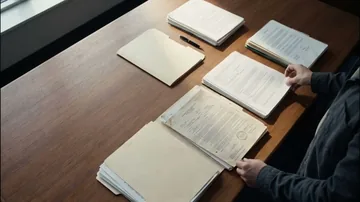
「上記」「後述」「別紙参照」“Above,” “below,” “see attached”

「上記」は、ページが固定されて
初めて使えるようになった。
“See above” only works
once pages are fixed.

別の場所を番号で指すには、場所が固定されていなければならない。ページは、冊子の本と印刷から生まれた。 To point elsewhere by number, places must be fixed — and pages came from bound books and printing.

巻物の時代には、場所を固定して指し示すことが難しいものでした。ページという単位が生まれたのは、紀元1世紀頃から広まった冊子の形の本(コデックス)によってです。さらに印刷によって、どの本でも同じページに同じ内容が来るようになり、「3ページ参照」や索引が意味を持つようになりました。 With scrolls, it was hard to fix and point to a location. The page as a unit came with the bound book (the codex), which spread from around the 1st century CE. Printing then put the same content on the same page in every copy, giving meaning to “see page 3” and to indexes.

読み手は、頭の中の「話の全体像」に指示表現を結びつけている。参照先が遠いほど、入れ子になるほど負担が大きい。 Readers attach references to a mental picture of the story so far — the farther or more nested the reference, the heavier the load.

「上記」のような言葉を理解するとき、人は読みながら頭の中に「今どんな話が進んでいるか」という全体像(状況モデル)を組み立て、その中の該当部分に結びつけています。代名詞を理解するのと同じ仕組みです。ただし状況モデルを保つのにも作業記憶を使うため、参照先が遠いほど、参照が入れ子になるほど、理解の負担が大きくなります。 To understand words like “above,” readers build a mental picture of what is going on as they read (a situation model) and link the word to the right part of it — the same mechanism as understanding pronouns. But keeping that model also uses working memory, so the farther away the target, or the more references are nested, the harder it gets.

「同上」「〃」“Ditto” and 〃

「〃」の意味は、記号ではなく
上下の位置にある。
The meaning of “ditto”
lives in position, not the mark.

英語の「ditto」は、イタリア語の「前に言った」に由来し、帳簿や目録で古くから使われてきた。 The English “ditto” comes from Italian for “said before,” and has long been used in ledgers and catalogues.

「ditto」はイタリア語の「detto」(前に言った)に由来し、同じ内容の繰り返しを省く記号として使われてきました。日本では「〃」を「ノノ点」とも呼びます。手書きの時代には、同じ言葉を何度も書く手間を省くことが大きな意味を持っていました。 “Ditto” comes from the Italian “detto” (said before) and has long served as a mark for skipping repeated content. In Japan the mark 〃 is also called “nono-ten.” In the age of handwriting, saving the effort of writing the same words again and again mattered a great deal.

縦に揃ったものを一続きと見る性質のおかげで、「〃」は上の行と同じだと分かる。だから行を並べ替えると意味が壊れる。 We read 〃 as “same as above” because we see vertically aligned items as one run — so reordering the rows breaks the meaning.

「〃」が上の行と同じだと分かるのは、ゲシュタルト心理学でいう、縦に揃ったものを一続きと見なす性質のおかげです。つまり「〃」の意味は、記号そのものではなく上下の位置関係に依存しています。そのため、行を並べ替えたり一部を抜き出したりすると、意味が壊れてしまいます。 We know 〃 means “same as the line above” thanks to the Gestalt tendency to see vertically aligned items as one continuous run. Its meaning depends not on the mark itself but on what sits above it — so sorting the rows or pulling out a single line breaks it.

「等」「など」“Etc.” and “and so on”

「等」は、典型例から
「似たもの」を思い浮かべさせる。
“Etc.” makes you imagine
“things like these.”

人は、すべての要素を並べた定義ではなく、典型的な例を中心にしたまとまりで物事を分類する。 We sort things not by lists of every member, but by groups centered on typical examples.

1970年代にアメリカの心理学者エレノア・ロッシュが示した「プロトタイプ理論」です。たとえば「鳥」と聞くと、ペンギンよりもスズメを思い浮かべ、スズメに似ているほど鳥らしいと感じます。 This is prototype theory, set out in the 1970s by the American psychologist Eleanor Rosch. Hear “bird” and you picture a sparrow rather than a penguin — and the more something resembles a sparrow, the more bird-like it feels.

「製品A、B等」は人の分類の仕方には合っているが、範囲の境界がはっきりしない。 “Products A, B, etc.” matches how people categorize — but its boundary is blurry.

「製品A、B等」という書き方は、AとBを典型例として示し、「これに似たもの」というまとまりを読み手に思い浮かべさせています。人間の分類の仕方には合っていますが、どこまでが含まれるのかがはっきりしないので、機械で処理したり、契約で争いになったりすると困ることになります。 “Products A, B, etc.” offers A and B as typical examples and invites the reader to picture “things like these.” That fits how people categorize, but because it never says where the group ends, it causes trouble when a machine has to process it or when a contract is disputed.

主語の省略The missing subject

主語が省略されても、
読み手は「誰か」を補っている。
Even with no subject,
readers supply the “who.”

日本語は、文脈から分かる主語や目的語を省略できる言語。 Japanese is a language that lets you drop subjects and objects clear from context.

アメリカの文化人類学者エドワード・ホールは、1976年の著書で、言葉にしない文脈に多くを頼る文化を「高文脈文化」と呼び、日本をその代表として挙げました。 In a 1976 book, the American anthropologist Edward T. Hall called cultures that rely heavily on unspoken context “high-context cultures,” and named Japan as a leading example.

人は会話で必要以上のことを言わない。分かり切ったことを言うと、かえって不自然になる。 People don't say more than they need to — stating the obvious actually sounds odd.

イギリスの哲学者ポール・グライスは1975年に、人は会話で必要以上のことを言わないという原則(量の格率:伝える情報は多すぎず少なすぎず、必要な分だけにする、という会話の決まり)に従っていると論じました。 In 1975 the British philosopher Paul Grice argued that people follow a principle of not saying more than is needed (the maxim of quantity: give as much information as is required, and no more).

主語を省いても伝わるのは、人が相手の立場や意図を推測する力を持っているから。 Dropping the subject works because people can infer others' positions and intentions.

主語を省略しても伝わるのは、人間が相手の立場や意図を推測する能力(心の理論:他人が何を考え、何をしようとしているかを推し量る力)を持っているからです。読み手は「この組織でこの作業をするのは誰か」を推測して補っています。 It works because people have a theory of mind — the ability to infer what others think and intend. Readers fill in the gap by working out who, in this organization, would do this task.

Documents 一覧へBack to Documents

参考:E. Rosch, “Cognitive representations of semantic categories,” Journal of Experimental Psychology: General (1975) / E. T. Hall, Beyond Culture (1976) / H. P. Grice, “Logic and Conversation” (1975) References: E. Rosch, “Cognitive representations of semantic categories,” Journal of Experimental Psychology: General (1975) / E. T. Hall, Beyond Culture (1976) / H. P. Grice, “Logic and Conversation” (1975)

書かれていない
文脈まで。
Context the page
leaves unwritten.

参照と省略を、御社の文書で補って読みます。See references and omissions resolved in your documents.