








Batch Assessment ・ Pro feature ・ AI agent

Bring assessments into a
standardized evaluation process.

Batch Assessment is an assessment-support feature in which an AI agent reviews the reference materials for each evaluation item, matches them against the information you need, and makes a first-pass decision.

With a lean team,
the assessment load runs high.

Assessment checklist items are defined from requirements inside and outside the organization — laws and regulations, industry standards, customer requirements, internal policies, security guidelines, and more. Those premises shift with the social and business environment, and as existing items are revised and new review angles are added, both the materials to reference and the content to judge keep growing.

Finding the evidence and putting it in a form you can explain
is harder still.

You have to locate where in a document the relevant statement lives, then leave an audit trail that a third party can follow. The more carefully you try to do these assessments, the longer the checking takes, and interpretations of each item vary from person to person. As a result, keeping evaluation quality consistent is hard, and running it as a controlled process has its limits.

01

The evidence is scattered across many materials

Policies, registers, logs, specs, contracts, past answers — the information needed for a check is often not gathered in one place.
Answering even a single item tends to require searching for the relevant passage across multiple materials.

02

The decision process tends to be person-dependent

Which materials did they look at?
Which statement did they base it on?
How did they interpret it, and why did they reach that decision?

This decision-making process tends to live in an individual's experience and memory, making it hard for a third party to verify later.

03

Interpretations of an item drift apart

Even for the same item, the scope each person checks and the angles they weight can differ.
As a result, the answers, the reasons, and the evidence required all diverge, making consistent quality hard to hold.

Batch Assessment

Take assessments into an era
you run together with an AI agent.

The essence of Batch Assessment is not just automating evaluation, but
building a first-pass decision process that leaves an audit trail and checks to the same standard every time.

*Videos are for illustrative purposes only.

The manual work people did one item at a time,
now run in one pass, item by item, by an AI agent.

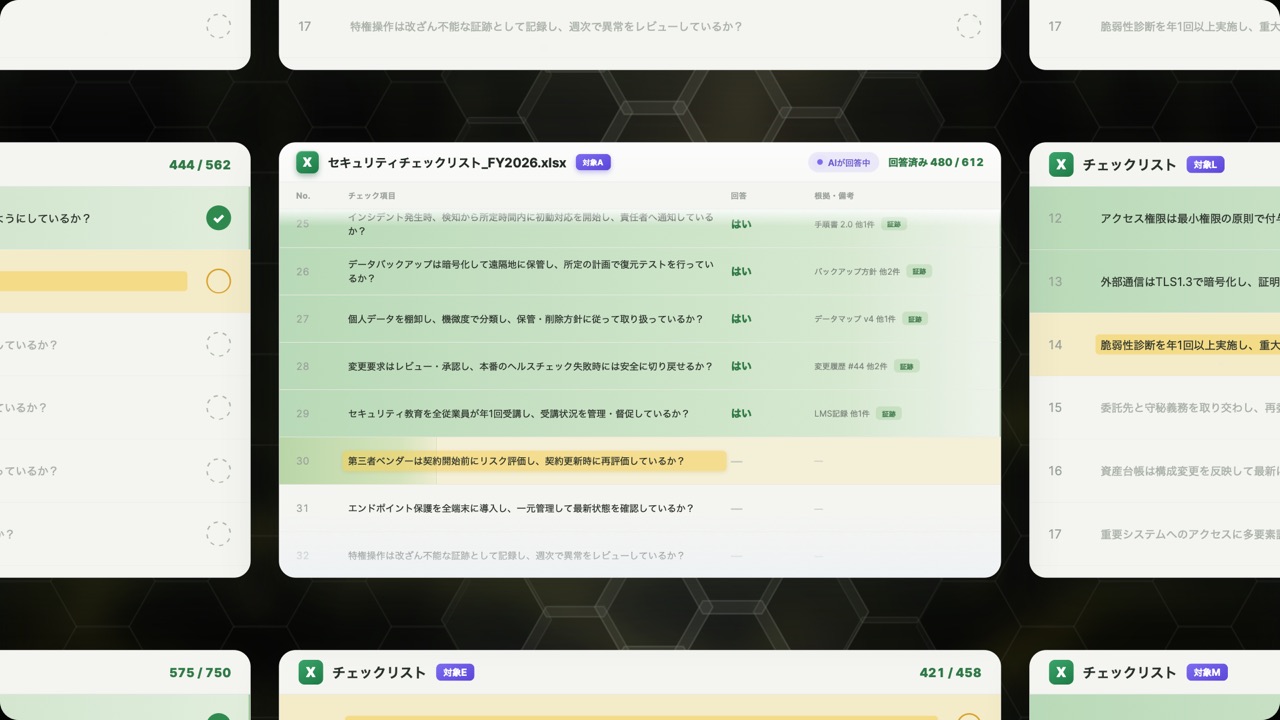
Batch Assessment takes the material review, evidence identification, requirement matching, and evaluation decisions that staff used to do one item at a time, and runs them in one pass, item by item, with an AI agent.

*Videos are for illustrative purposes only.

The AI agent makes the first-pass decision,
and your staff become reviewers.

Because Batch Assessment lets you see not only the result but why the evaluation came out that way, it doubles as an audit trail that's easy to review afterward.

*Videos are for illustrative purposes only.

You can trust it because you can check "why it decided that"
and "where it's written" down to the source

Batch Assessment doesn't just decide the result — for each item it organizes which statement in which material it referenced, why it arrived at that draft evaluation, and what information is still missing to decide.

*Videos are for illustrative purposes only.

Decision

Shows the first-pass decision the AI agent made for each evaluation item.

It evaluates according to predefined decision categories such as "Compliant," "Not compliant," "Out of scope," or "Cannot decide."

Reason

Explains why it reached that decision, based on the content of the referenced materials and the decision criteria.

It lays out the reasoning behind the decision in prose, so staff can review it easily.

Excerpt

Shows the relevant passage within the document that served as the basis for the decision.

By checking the excerpt, staff can immediately see which statement the AI's decision rests on.

Source

Shows the source material's name, page, section, file name, and more.

It keeps everything in a state where you can verify the basis later and trace the source during review or audit.

Transform assessments at the root,
redirecting effort to follow-up and analysis.

Mechanical work — hunting for evidence and filling in evaluation sheets — grows in proportion as items increase. Batch Assessment hands that mechanical work to an AI agent, freeing up time for the things people should be spending it on: confirming whether the evidence meets the requirements, and moving ahead with countermeasures for the items not yet addressed.

*Videos are for illustrative purposes only.

Establish a unified,
highly reproducible generative-AI workflow across the org.

Batch Assessment lets you run the same checking work repeatedly under the same conditions, the same standards, and the same output format. Instead of generic AI chat — where the choice of files, the prompts, the decision criteria, and the output format change from person to person — you run with the checklist, reference materials, evaluation criteria, and review angles all lined up in advance.

Generic AI chat

Each time, staff gather files, write the prompt, and evaluate the output. Convenient, but the quality of the prompts and the review angles depend heavily on the person.

Batch Assessment

The organization's knowledge, evaluation criteria, and output format are defined in advance. Whoever runs it, the same framework produces an evidence-backed first-pass decision.

*Videos are for illustrative purposes only.

Make usage visible,
toward an evaluation process you can keep improving.

Batch Assessment isn't a run-once-and-done tool. Administrators can see which Batch Assessments are in use across the organization, which checklists have been run, and how many items have been processed.

By reviewing execution status, review status, the number of items processed, and the output results, you can make ROI visible and understand how each department is putting it to use.

*Videos are for illustrative purposes only.

AskDona

Only AskDona makes it possible:
an evidence-based assessment process.

Not an AI that just answers, but an AI that moves your checking work forward. It connects the technology behind evidence-backed answers straight into the real work of evaluation, decision, and extraction.

1

Register your knowledge

Register policies, procedures, management registers, evidence, specs, contracts, and past answers in AskDona.

2

Register your checklist

Register the question items, evaluation items, and extraction fields managed in Excel and elsewhere.

3

Set the evaluation criteria

Administrators set the decision categories, answer policy, the knowledge to reference, and the output columns.

4

Generative AI evaluates everything in one pass

For each item, it finds the related documents and outputs the draft answer, decision, reason, source, and missing info.

5

People review and finalize the evaluation

Staff review the AI's decision and its evidence, correct it as needed, and then finalize the evaluation.

Batch
Assessment

Turn time spent on manual work
into time for concrete improvement actions.

Frequently asked questions

Yes — files uploaded to the RAG database are managed on servers within Japan.

Yes. AskDona enforces strict logical separation of customer data based on login credentials, so other customers cannot access your data.

For organizations whose policies prohibit moving internal data outside, AskDona can also be deployed into your own contracted cloud (AWS, GCP). Contact us for details.

AskDona supports major formats — PDF, Word (.docx), PowerPoint (.pptx), Excel (.xlsx), CSV, HTML, Markdown, and image files. Contact us for capacity and operational limits.

No. Questions and uploaded files sent to AskDona are never used to train ChatGPT or other generative-AI models. Any models we adopt going forward will be limited to those covered by no-training-on-customer-data agreements.