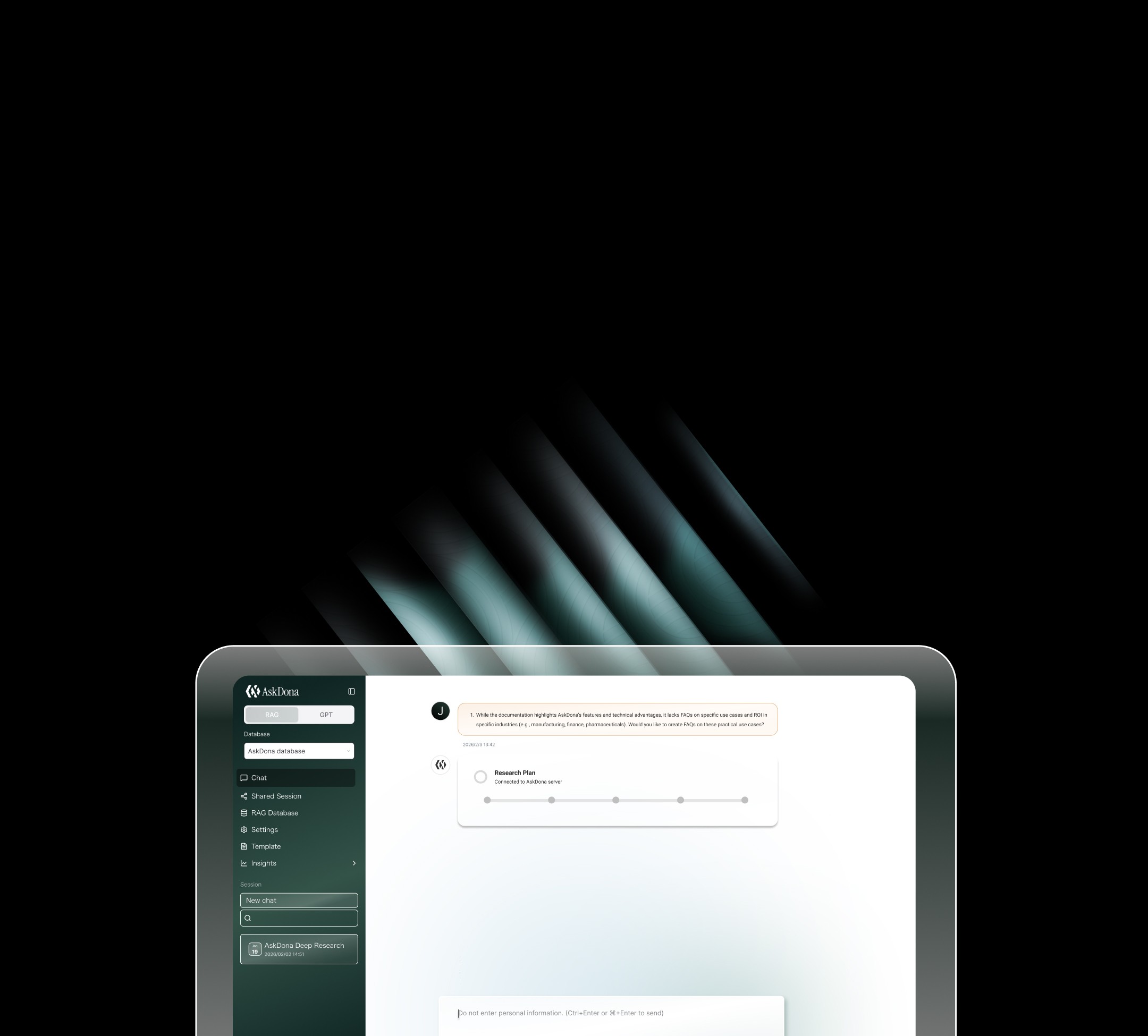
UNDERSTAND WHAT'S WRITTEN ACROSS ALL YOUR INTERNAL DOCUMENTS
Deep Research allows you to investigate information from the sources that make sense for your task.
Depending on your needs, you can run research across:

Internal Knowledge
Internal documents and organizational knowledge only

Web Sources
Cross-domain research using public web data only.

Unified Investigation
Both internal knowledge and web sources together
You decide the scope. The AI agent follows your instruction.
When information is scattered, research becomes manual
When you want to investigate a specific topic, the challenge is rarely finding some information.
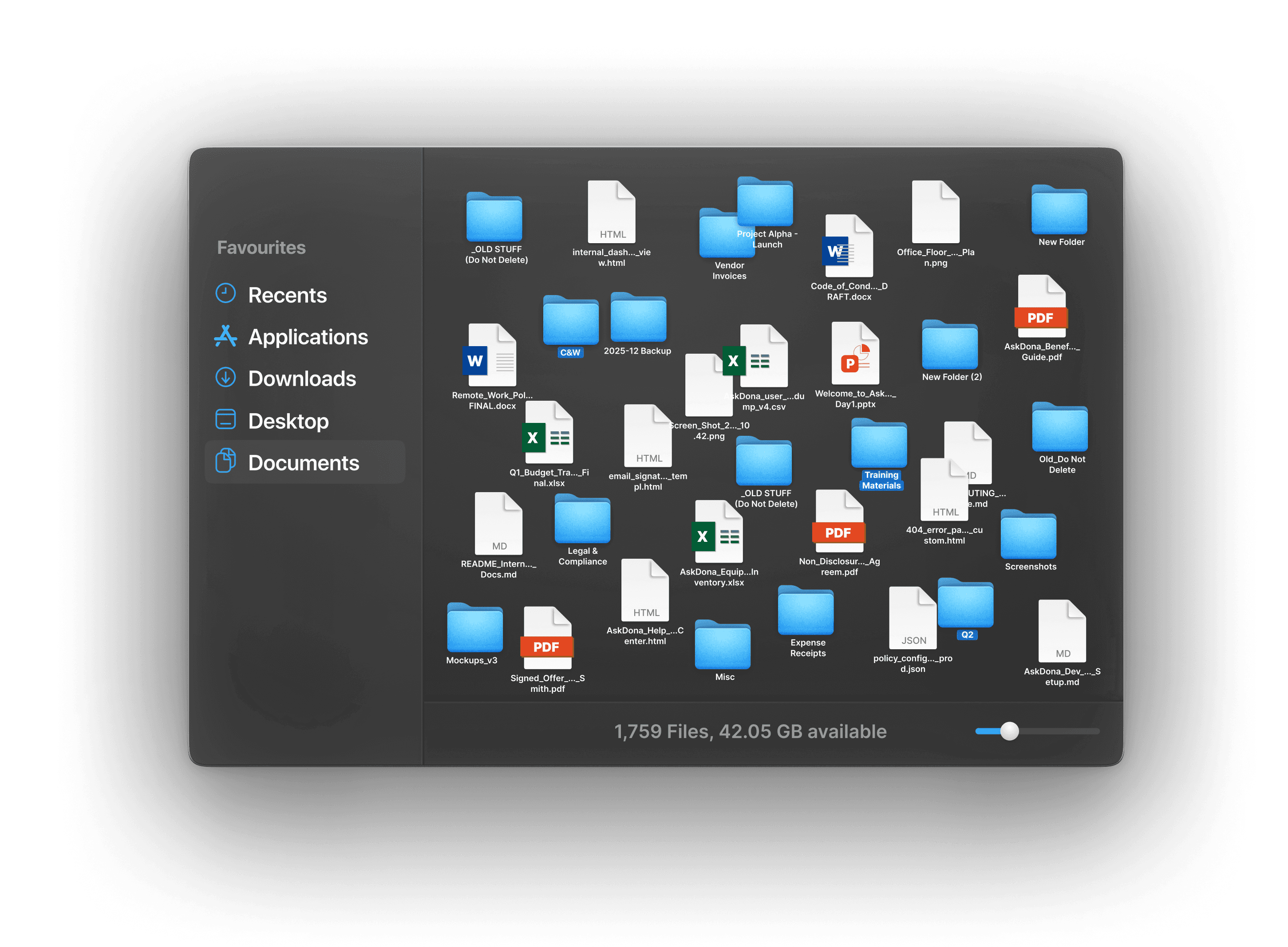
How many documents mention the topic
Where those mentions appear
What each document actually says
The real challenge is understanding:
Repeated searches
Careful reading
Manual cross-checking
Reliance on personal memory
This usually requires:

Even then, coverage is never guaranteed. Deep Research is built to solve this problem.
From Manual Research to Agent-Driven Investigation
With Deep Research, tasks that were previously handled manually are carried out by a Generative AI agent.
Instead of reading and searching documents yourself, you ask the agent to investigate on your behalf.
The agent:
Searches across documents and web sources
Identifies relevant references
Collects and organizes findings
while you stay focused on direction and judgment.
UNDERSTAND WHAT'S WRITTEN ACROSS ALL YOUR INTERNAL DOCUMENTS
Deep Research allows you to investigate information from the sources that make sense for your task.
Depending on your needs, you can run research across:
Internal Knowledge
Internal documents and organizational knowledge only
Web Sources
Cross-domain research using public web data only.
Unified Investigation
Both internal knowledge and web sources together
You decide the scope. The AI agent follows your instruction.
When information is scattered, research becomes manual
When you want to investigate a specific topic, the challenge is rarely finding some information.
How many documents mention the topic
Where those mentions appear
What each document actually says
The real challenge is understanding:
Repeated searches
Careful reading
Manual cross-checking
Reliance on personal memory
This usually requires:
Even then, coverage is never guaranteed. Deep Research is built to solve this problem.
From Manual Research to Agent-Driven Investigation
With Deep Research, tasks that were previously handled manually are carried out by a Generative AI agent.
Instead of reading and searching documents yourself, you ask the agent to investigate on your behalf.
The agent:
Searches across documents and web sources
Identifies relevant references
Collects and organizes findings
while you stay focused on direction and judgment.
UNDERSTAND WHAT'S WRITTEN ACROSS ALL YOUR INTERNAL DOCUMENTS
Deep Research allows you to investigate information from the sources that make sense for your task.
Depending on your needs, you can run research across:
Internal Knowledge
Internal documents
and organizational knowledge only
Web Sources
Cross-domain research using public web data only.
Unified Investigation
Both internal knowledge and web sources together
You decide the scope.
The AI agent follows your instruction.
When information is scattered,
research becomes manual
When you want to investigate a specific topic, the challenge is rarely finding some information.
The real challenge is understanding:
How many documents mention the topic
Where those mentions appear
What each document actually says
This usually requires:
Repeated searches
Careful reading
Manual cross-checking
Reliance on personal memory
Even then, coverage is never guaranteed. Deep Research is built to solve this problem.
From Manual Research to Agent-Driven Investigation
With Deep Research, tasks that were previously handled manually are carried out by a Generative AI agent.
Instead of reading and searching documents yourself, you ask the agent to investigate on your behalf.
The agent:
Searches across documents and web sources
Identifies relevant references
Collects and organizes findings
while you stay focused on direction and judgment.
UNDERSTAND WHAT'S WRITTEN ACROSS ALL YOUR INTERNAL DOCUMENTS
Deep Research allows you to investigate information from the sources that make sense for your task.
Depending on your needs, you can run research across:
Internal Knowledge
Internal documents
and organizational knowledge only
Web Sources
Cross-domain research using public web data only.
Unified Investigation
Both internal knowledge and web sources together
You decide the scope.
The AI agent follows your instruction.
When information is scattered,
research becomes manual
When you want to investigate a specific topic, the challenge is rarely finding some information.
The real challenge is understanding:
How many documents mention the topic
Where those mentions appear
What each document actually says
This usually requires:
Repeated searches
Careful reading
Manual cross-checking
Reliance on personal memory
Even then, coverage is never guaranteed. Deep Research is built to solve this problem.
From Manual Research to Agent-Driven Investigation
With Deep Research, tasks that were previously handled manually are carried out by a Generative AI agent.
Instead of reading and searching documents yourself, you ask the agent to investigate on your behalf.
The agent:
Searches across documents and web sources
Identifies relevant references
Collects and organizes findings
while you stay focused on direction and judgment.
Step 1: Assign a Research Task
You begin by telling the AI agent:
What you want to investigate
The purpose of the research
The type of output you expect
Effective use of Deep Research starts with proper database design.
Learn more about RAG database design here.

Step 2: The agent plans the research
Before collecting information, the AI agent first determines how the research should be conducted.
It reviews:
Available internal databases
Relevant web sources
Based on this preparation, the agent generates follow-up questions.
Step 3: Clarify assumptions before investigation
These follow-up questions help:
Confirm assumptions
Identify missing context
Prevent unnecessary rework later
This mirrors how experienced researchers prepare before starting a detailed investigation.
You respond with the necessary context, and the agent proceeds.
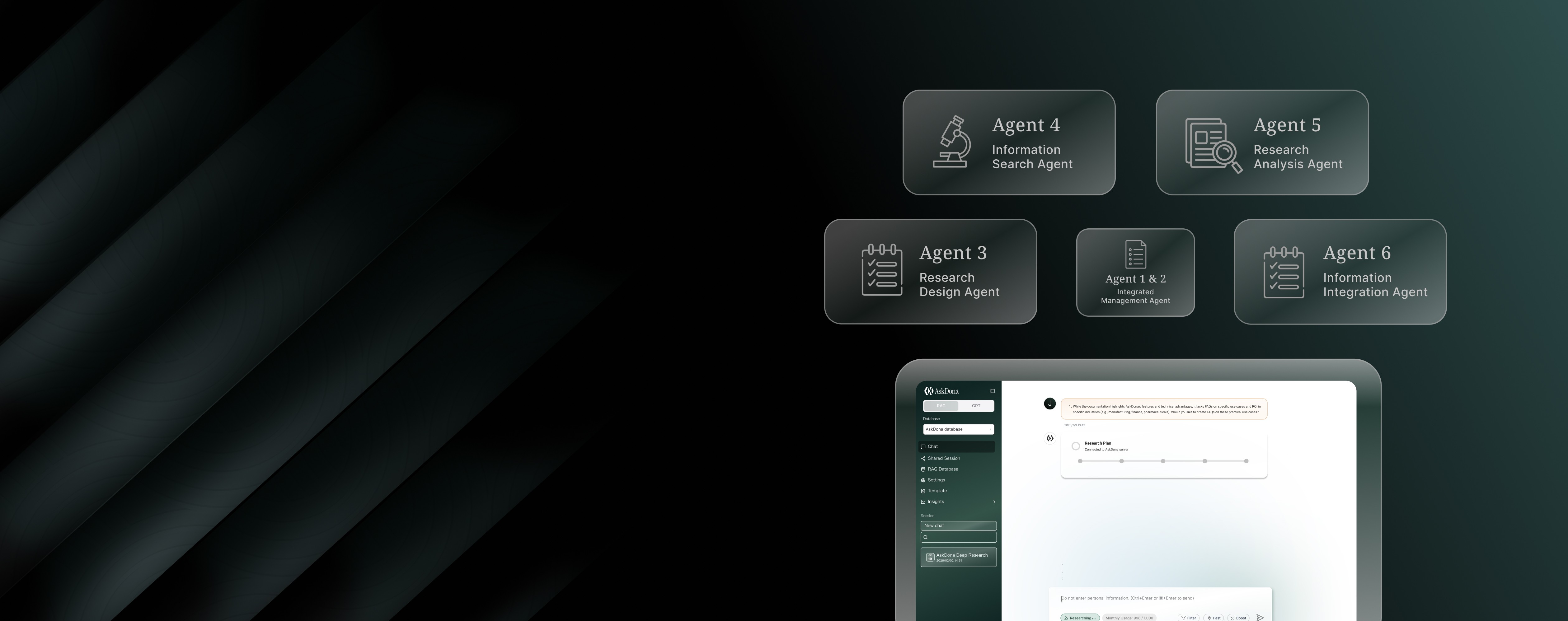
Step 4: The agent conducts the investigation
With sufficient context, the AI agent autonomously:
Defines research items
Searches internal and external sources
Aggregates findings
Continues until all research tasks are complete
The number of referenced sources can range from dozens to hundreds.
Step 4: The agent conducts the investigation
With sufficient context, the AI agent autonomously:
Defines research items
Searches internal and external sources
Aggregates findings
Continues until all research tasks are complete
The number of referenced sources can range from dozens to hundreds.
Step 5: Turn findings into usable output
Once the investigation is complete, Deep Research focuses on output.
It:
Consolidates large volumes of information
Structures the content logically
Generates reports in your preferred format
The result is research output that can be used directly in real work.
Frequently asked questions
Frequently asked questions
Frequently asked questions
Will the data I upload to the RAG database be stored on a domestic server?
Yes, files uploaded to the RAG database are managed on servers within Japan.
Is the AskDona usage environment separated from other companies?
Can I use AskDona in my own cloud environment?
What are the file formats and capacity limits that can be stored in RAG?
Will internal data be used to train ChatGPT?



Start with a free consultation.
AskDona is dedicated to Redefining Roles. We empower your organization by assigning all AI-capable tasks to the technology, allowing you to focus on critical human functions and innovation.
Deep Research
Batch Analysis
Reports
Articles
Start with a free consultation.
AskDona is dedicated to Redefining Roles. We empower your organization by assigning all AI-capable tasks to the technology, allowing you to focus on critical human functions and innovation.
Deep Research
Batch Analysis
Reports
Articles
Start with a free consultation.
AskDona is dedicated to Redefining Roles. We empower your organization by assigning all AI-capable tasks to the technology, allowing you to focus on critical human functions and innovation.
Deep Research
Batch Analysis
Reports
Articles

UNDERSTAND WHAT'S WRITTEN ACROSS ALL YOUR INTERNAL DOCUMENTS
Deep Research allows you to investigate information from the sources that make sense for your task.
Depending on your needs, you can run research across:
Internal Knowledge
Internal documents and organizational knowledge only
Web Sources
Cross-domain research using public web data only.
Unified Investigation
Both internal knowledge and web sources together
You decide the scope. The AI agent follows your instruction.
When information is scattered, research becomes manual
When you want to investigate a specific topic, the challenge is rarely finding some information.
How many documents mention the topic
Where those mentions appear
What each document actually says
The real challenge is understanding:
Repeated searches
Careful reading
Manual cross-checking
Reliance on personal memory
This usually requires:
Even then, coverage is never guaranteed. Deep Research is built to solve this problem.
From Manual Research to Agent-Driven Investigation
With Deep Research, tasks that were previously handled manually are carried out by a Generative AI agent.
Instead of reading and searching documents yourself, you ask the agent to investigate on your behalf.
The agent:
Searches across documents and web sources
Identifies relevant references
Collects and organizes findings
while you stay focused on direction and judgment.
UNDERSTAND WHAT'S WRITTEN ACROSS ALL YOUR INTERNAL DOCUMENTS
Deep Research allows you to investigate information from the sources that make sense for your task.
Depending on your needs, you can run research across:
Internal Knowledge
Internal documents and organizational knowledge only
Web Sources
Cross-domain research using public web data only.
Unified Investigation
Both internal knowledge and web sources together
You decide the scope. The AI agent follows your instruction.
When information is scattered, research becomes manual
When you want to investigate a specific topic, the challenge is rarely finding some information.
How many documents mention the topic
Where those mentions appear
What each document actually says
The real challenge is understanding:
Repeated searches
Careful reading
Manual cross-checking
Reliance on personal memory
This usually requires:
Even then, coverage is never guaranteed. Deep Research is built to solve this problem.
From Manual Research to Agent-Driven Investigation
With Deep Research, tasks that were previously handled manually are carried out by a Generative AI agent.
Instead of reading and searching documents yourself, you ask the agent to investigate on your behalf.
The agent:
Searches across documents and web sources
Identifies relevant references
Collects and organizes findings
while you stay focused on direction and judgment.
Step 4: The agent conducts the investigation
With sufficient context, the AI agent autonomously:
Defines research items
Searches internal and external sources
Aggregates findings
Continues until all research tasks are complete
The number of referenced sources can range from dozens to hundreds.
Step 4: The agent conducts the investigation
With sufficient context, the AI agent autonomously:
Defines research items
Searches internal and external sources
Aggregates findings
Continues until all research tasks are complete
The number of referenced sources can range from dozens to hundreds.
Step 2: The agent plans the research
Before collecting information, the AI agent first determines how the research should be conducted.
It reviews:
Available internal databases
Relevant web sources
Based on this preparation, the agent generates follow-up questions.
Step 2: The agent plans the research
Before collecting information, the AI agent first determines how the research should be conducted.
It reviews:
Available internal databases
Relevant web sources
Based on this preparation, the agent generates follow-up questions.
Step 1: Assign a Research Task
You begin by telling the AI agent:
What you want to investigate
The purpose of the research
The type of output you expect
Effective use of Deep Research starts with proper database design.
Learn more about RAG database design here.
Step 3: Clarify assumptions before investigation
These follow-up questions help:
Confirm assumptions
Identify missing context
Prevent unnecessary rework later
This mirrors how experienced researchers prepare before starting a detailed investigation.
You respond with the necessary context, and the agent proceeds.
Step 5: Turn findings into usable output
Once the investigation is complete, Deep Research focuses on output.
It:
Consolidates large volumes of information
Structures the content logically
Generates reports in your preferred format
The result is research output that can be used directly in real work.
Step 1: Assign a Research Task
You begin by telling the AI agent:
What you want to investigate
The purpose of the research
The type of output you expect
Effective use of Deep Research starts with proper database design.
Learn more about RAG database design here.
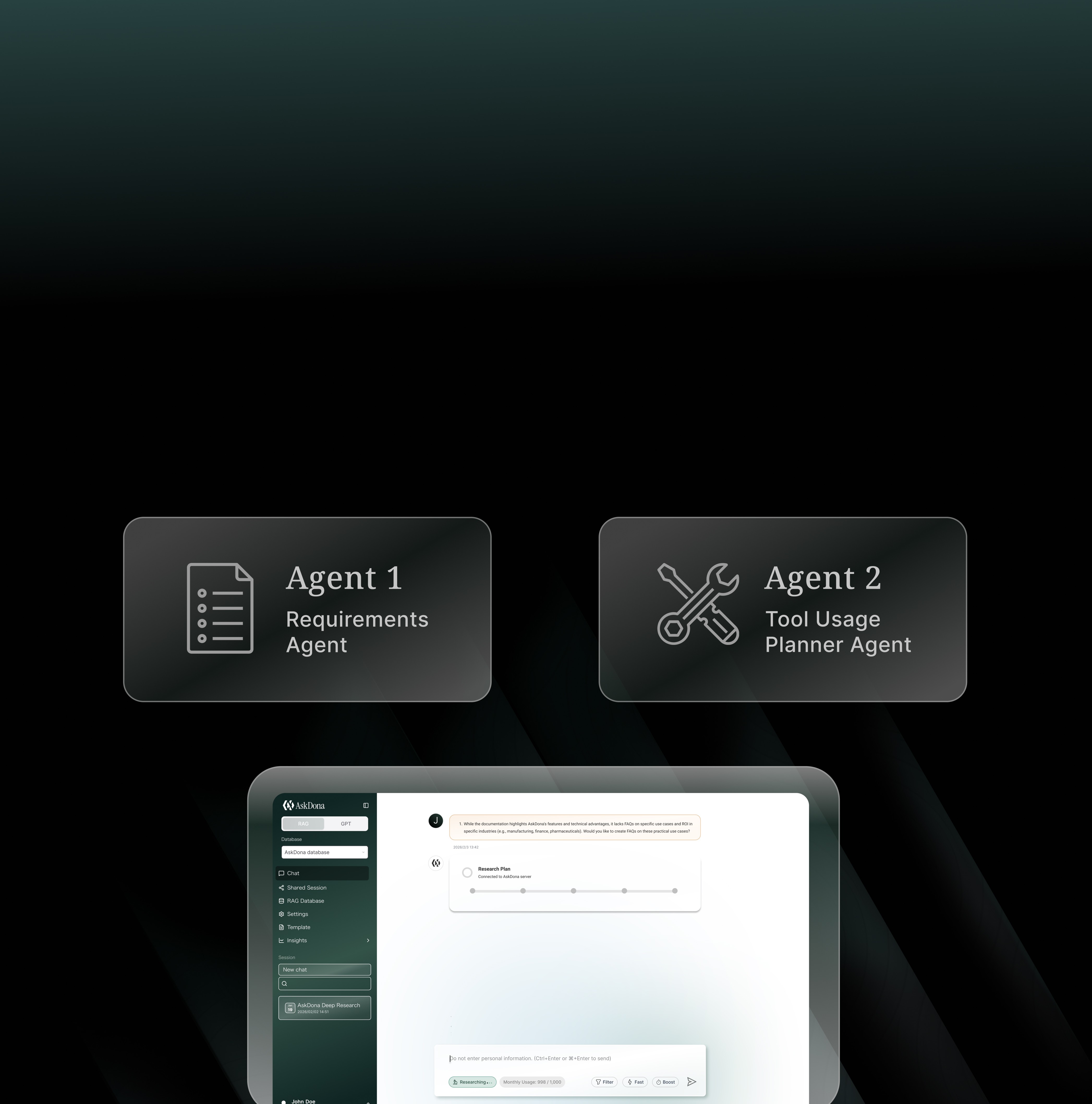
Step 2: The agent plans the research
Before collecting information, the AI agent first determines how the research should be conducted.
It reviews:
Available internal databases
Relevant web sources
Based on this preparation, the agent generates follow-up questions.
Step 2: The agent plans the research
Before collecting information, the AI agent first determines how the research should be conducted.
It reviews:
Available internal databases
Relevant web sources
Based on this preparation, the agent generates follow-up questions.
Step 3: Clarify assumptions before investigation
These follow-up questions help:
Confirm assumptions
Identify missing context
Prevent unnecessary rework later
This mirrors how experienced researchers prepare before starting a detailed investigation.
You respond with the necessary context, and the agent proceeds.
Step 5: Turn findings into usable output
Once the investigation is complete, Deep Research focuses on output.
It:
Consolidates large volumes of information
Structures the content logically
Generates reports in your preferred format
The result is research output that can be used directly in real work.
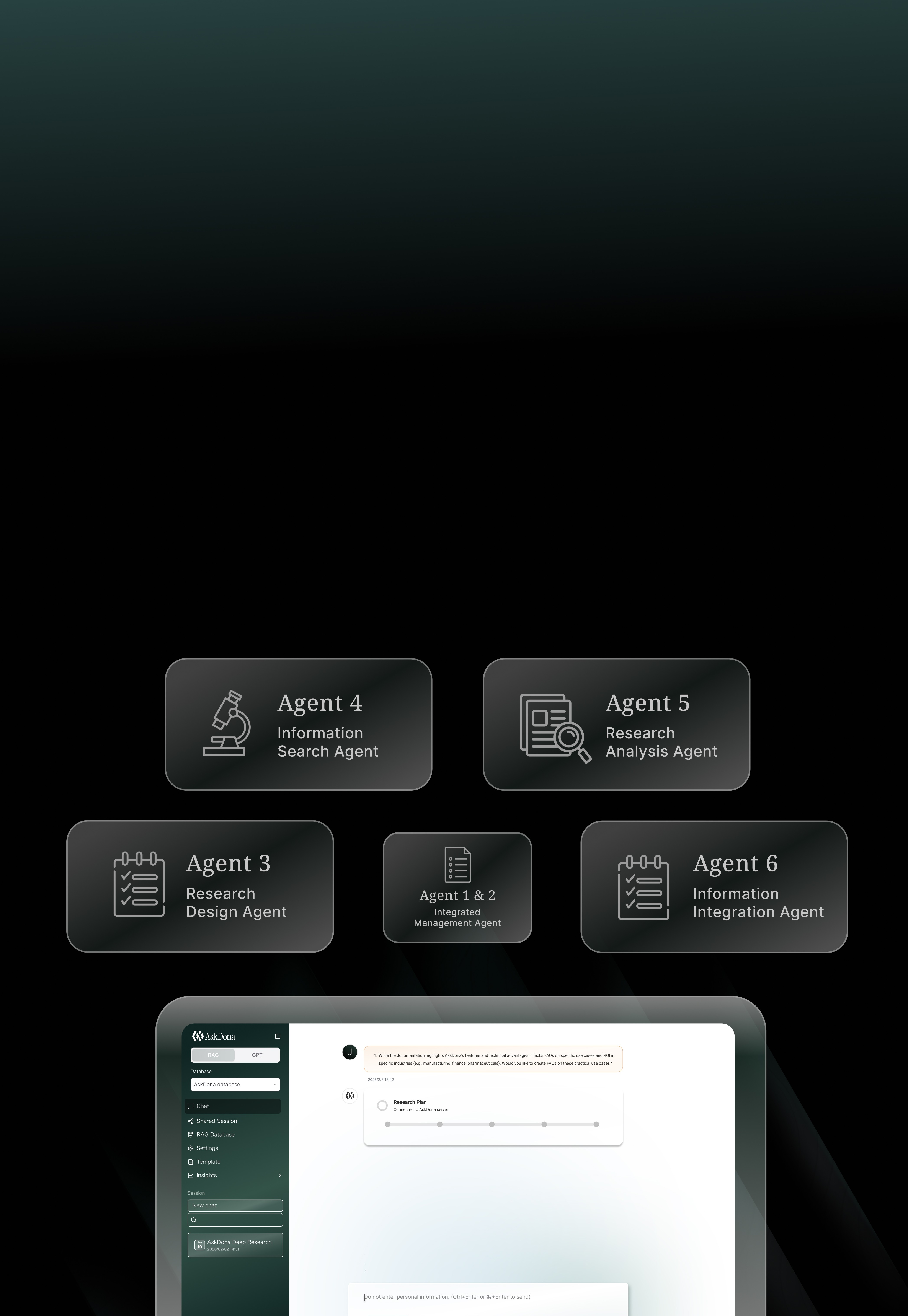
Step 4: The agent conducts the investigation
With sufficient context, the AI agent autonomously:
Defines research items
Searches internal and external sources
Aggregates findings
Continues until all research tasks are complete
The number of referenced sources can range from dozens to hundreds.
Step 4: The agent conducts the investigation
With sufficient context, the AI agent autonomously:
Defines research items
Searches internal and external sources
Aggregates findings
Continues until all research tasks are complete
The number of referenced sources can range from dozens to hundreds.
Step 1: Assign a Research Task
You begin by telling the AI agent:
What you want to investigate
The purpose of the research
The type of output you expect
Effective use of Deep Research starts with proper database design.
Learn more about RAG database design here.

Step 2: The agent plans the research
Before collecting information, the AI agent first determines how the research should be conducted.
It reviews:
Available internal databases
Relevant web sources
Based on this preparation, the agent generates follow-up questions.
Step 2: The agent plans the research
Before collecting information, the AI agent first determines how the research should be conducted.
It reviews:
Available internal databases
Relevant web sources
Based on this preparation, the agent generates follow-up questions.
Step 3: Clarify assumptions before investigation
These follow-up questions help:
Confirm assumptions Identify missing context
Prevent unnecessary rework later
This mirrors how experienced researchers prepare before starting a detailed investigation.
You respond with the necessary context, and the agent proceeds.
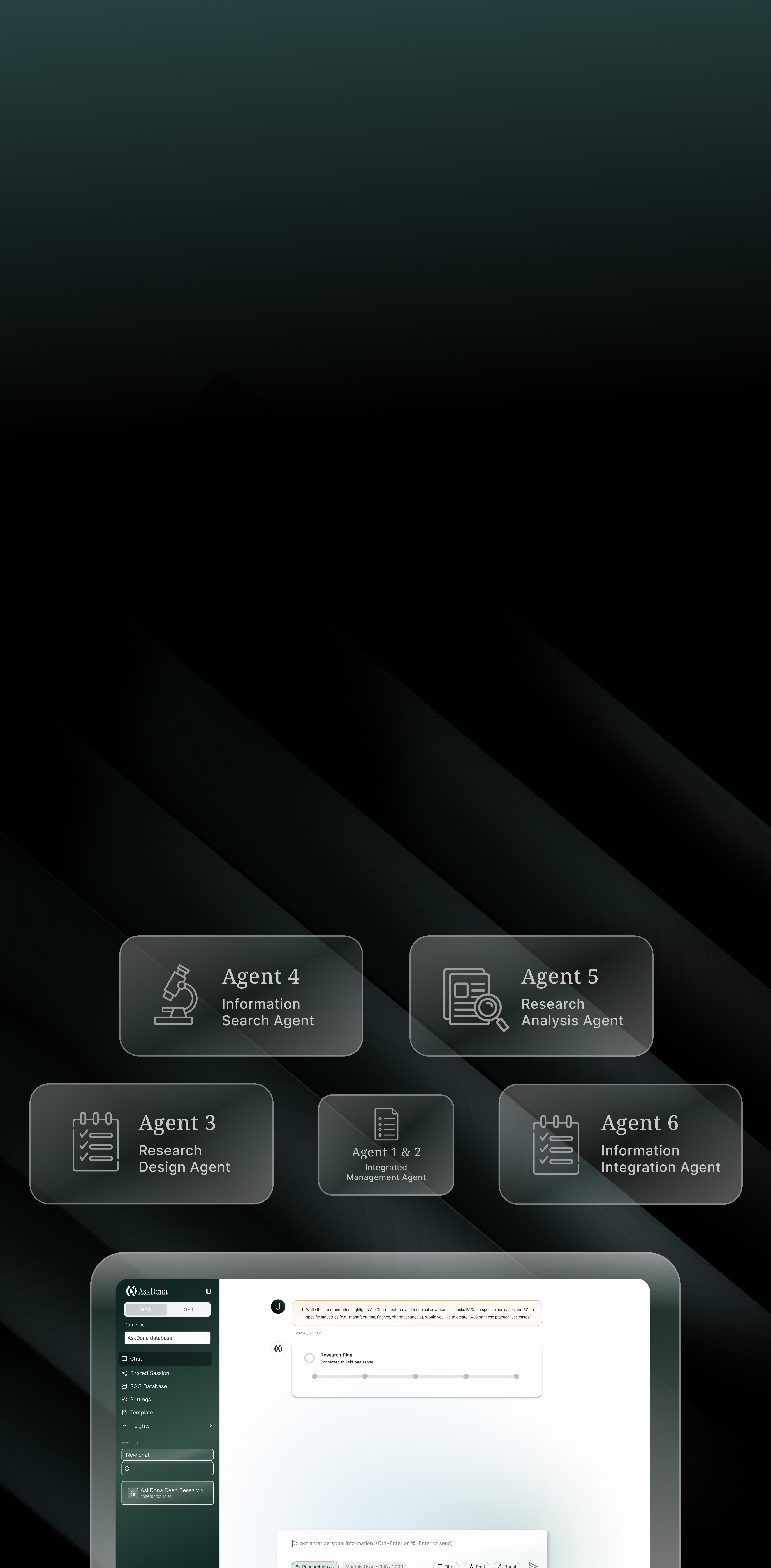
Step 4: The agent conducts the investigation
With sufficient context, the AI agent autonomously:
Defines research items
Searches internal and external sources
Aggregates findings
Continues until all research tasks are complete
The number of referenced sources can range from dozens to hundreds.
Step 4: The agent conducts the investigation
With sufficient context, the AI agent autonomously:
Defines research items
Searches internal and external sources
Aggregates findings
Continues until all research tasks are complete
The number of referenced sources can range from dozens to hundreds.
Step 5: Turn findings into usable output
Once the investigation is complete, Deep Research focuses on output.
It:
Consolidates large volumes of information
Structures the content logically
Generates reports in your preferred format
The result is research output that can be used directly in real work.