
Do you have any of these concerns when introducing RAG?
Do you have any of these concerns when introducing RAG?
Challenges in Utilizing Internal Documents
"There’s so much data that finding the right file takes time."
"Internal documents are complex and spread across multiple files, making them hard to understand."
"We want AI to handle repetitive inquiries."
Pitfalls of Building RAG In-House
Common RAG Challenges
Pitfalls of Building RAG In-House
“We built RAG in-house, but answer accuracy hasn’t reached our expectations…”
“As data volume grows, the AI’s responses become more off-target…”
“We see RAG’s potential, but don’t know how to use it across the organization…”
“We built RAG in-house, but answer accuracy hasn’t reached our expectations…”
“As data volume grows, the AI’s responses become more off-target…”
“We see RAG’s potential, but don’t know how to use it across the organization…”
“We tried implementing RAG, but accuracy didn’t improve and the project stalled.”
“Maintenance and improvements lagged, making RAG ineffective.”
“It’s hard to measure RAG’s effectiveness, making ROI unclear.”
“We tried implementing RAG, but accuracy didn’t improve and the project stalled.”
“Maintenance and improvements lagged, making RAG ineffective.”
“It’s hard to measure RAG’s effectiveness, making ROI unclear.”
“We built RAG in-house, but answer accuracy hasn’t reached our expectations…”
“As data volume grows, the AI’s responses become more off-target…”
“We see RAG’s potential, but don’t know how to use it across the organization…”
Pitfalls of Building RAG In-House
Pitfalls of Building RAG In-House
Common RAG Challenges
“We built RAG in-house, but answer accuracy hasn’t reached our expectations…”
“As data volume grows, the AI’s responses become more off-target…”
“We see RAG’s potential, but don’t know how to use it across the organization…”
Pitfalls of Building RAG In-House
Pitfalls of Building RAG In-House
Common RAG Challenges
“We built RAG in-house, but answer accuracy hasn’t reached our expectations…”
“As data volume grows, the AI’s responses become more off-target…”
“We see RAG’s potential, but don’t know how to use it across the organization…”
「RAGを内製化したものの、期待した回答精度まで上がらない...」
「データ量が増えるほど、生成AIの回答が的外れになってしまう...」
「RAGのポテンシャルは感じるけど、組織全体での活用方法が見えない...」
「RAG導入に挑戦したものの、回答精度が向上せず頓挫してしまった」
「メンテナンスや改善に手が回らず、RAGが形骸化してしまっている」
「RAGの効果測定が難しく、投資対効果が見えづらい」
What is RAG and why do we need it?
What is RAG and why do we need it?
Do you have any of these concerns when introducing RAG?
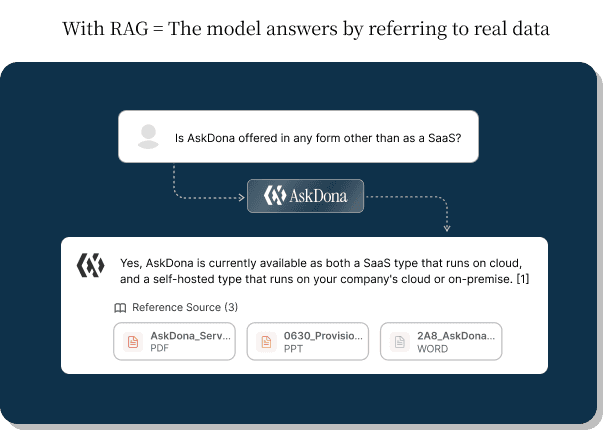
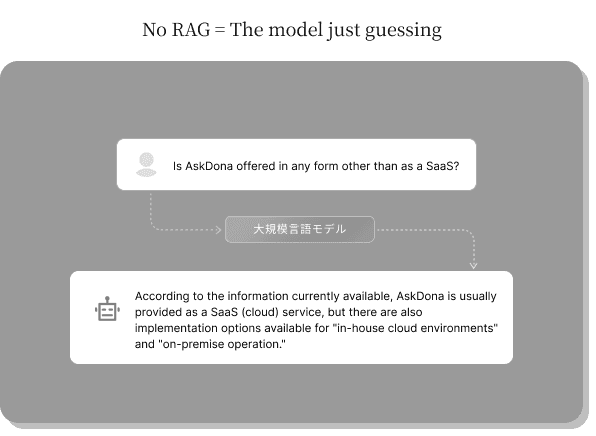
RAG (Retrieval-Augmented Generation) is a method that improves AI accuracy by letting a language model search and reference external data (documents, knowledge bases) before generating an answer. Instead of guessing from its training data alone, the model retrieves relevant information and uses it to produce more reliable, fact-based responses.
RAG (Retrieval-Augmented Generation) is a method that improves AI accuracy by letting a language model search and reference external data (documents, knowledge bases) before generating an answer. Instead of guessing from its training data alone, the model retrieves relevant information and uses it to produce more reliable, fact-based responses.
“We built RAG in-house, but answer accuracy hasn’t reached our expectations…”
“As data volume grows, the AI’s responses become more off-target…”
“We see RAG’s potential, but don’t know how to use it across the organization…”
Pitfalls of Building RAG In-House
R = Retrieval - The step where the AI searches for and gathers relevant information.
A = Augmented - “Enhanced” or “strengthened.” The retrieved information is used to boost the model’s abilities.
G = Generation - The AI creates the final answer or text using the enhanced information.
R = Retrieval - The step where the AI searches for and gathers relevant information.
A = Augmented - “Enhanced” or “strengthened.” The retrieved information is used to boost the model’s abilities.
G = Generation - The AI creates the final answer or text using the enhanced information.
“We built RAG in-house, but answer accuracy hasn’t reached our expectations…”
“As data volume grows, the AI’s responses become more off-target…”
“We see RAG’s potential, but don’t know how to use it across the organization…”
“We tried implementing RAG, but accuracy didn’t improve and the project stalled.”
“Maintenance and improvements lagged, making RAG ineffective.”
“It’s hard to measure RAG’s effectiveness, making ROI unclear.”
Pitfalls of Building RAG In-House
Common RAG Challenges
What is RAG and why do we need it?
RAG (Retrieval-Augmented Generation) is a method that improves AI accuracy by letting a language model search and reference external data (documents, knowledge bases) before generating an answer. Instead of guessing from its training data alone, the model retrieves relevant information and uses it to produce more reliable, fact-based responses.
R = Retrieval - The step where the AI searches for and gathers relevant information.
A = Augmented - "Enhanced" or "strengthened". The retrived information is used to boost the model's abilities.
G = Generation - The AI creates the final answer or text using the enhanced information.
AskDona: dona-rag-2.0
AskDona: dona-rag-2.0
AskDona (dona-rag-2.0)’s underlying RAG (Retrieval-Augmented Generation) is built with a proprietary mechanism. By performing three steps—“Upload,” “Metadata Edit,” and “Process”—on the administration console, users can handle the complex processes described below. A key feature of AskDona is its very high answer accuracy, made possible by properly and precisely processing the data through each process.
AskDona (dona-rag-2.0)’s underlying RAG (Retrieval-Augmented Generation) is built with a proprietary mechanism. By performing three steps—“Upload,” “Metadata Edit,” and “Process”—on the administration console, users can handle the complex processes described below. A key feature of AskDona is its very high answer accuracy, made possible by properly and precisely processing the data through each process.
AskDona (dona-rag-2.0)’s underlying RAG (Retrieval-Augmented Generation) is built with a proprietary mechanism. By performing three steps—“Upload,” “Metadata Edit,” and “Process”—on the administration console, users can handle the complex processes described below. A key feature of AskDona is its very high answer accuracy, made possible by properly and precisely processing the data through each process.
Pre-processing
The pre-processing phase refers to the set of steps carried out before live operation begins (providing answers to users), in which the documents and other information sources that serve as the basis for responses are prepared and organized into a knowledge base. With AskDona, users can perform this pre-processing themselves through the RAGChat feature. By following the on-screen guidance to upload data and executing the “Process” action, AskDona (dona-rag-2.0) automatically runs its processing workflow in the background and builds the knowledge base. There is no need to convert your data into a Q&A format or to manually process or format it for learning purposes; the data can be uploaded as-is, and because no tuning is required, high-quality responses can be achieved in a short time.
Pre-processing
The pre-processing phase refers to the set of steps carried out before live operation begins (providing answers to users), in which the documents and other information sources that serve as the basis for responses are prepared and organized into a knowledge base. With AskDona, users can perform this pre-processing themselves through the RAGChat feature. By following the on-screen guidance to upload data and executing the “Process” action, AskDona (dona-rag-2.0) automatically runs its processing workflow in the background and builds the knowledge base. There is no need to convert your data into a Q&A format or to manually process or format it for learning purposes; the data can be uploaded as-is, and because no tuning is required, high-quality responses can be achieved in a short time.
Information Extraction Model
Information extraction model
Information extraction model
Information extraction model
When you “upload” the documents at hand and click “process,” the system extracts information including text, images, tables, figures, and graphs contained in the document (Information extraction model). The model not only reads the surrounding text of images, but can also interpret the meaning of the images, the relationships between arrows, graphs, and tables, understand their semantics, and store them as data. It also supports mathematical formulas and chemical formulas, enabling accurate reading of academic papers and research data. Supported uploadable file formats include Microsoft Excel (.xlsx/.xls), PowerPoint (.pptx/.ppt), Word (.docx/.doc), and also PDF, CSV, and HTML files. In addition, by registering proper nouns specific to the organization as a glossary, the system is equipped with a mechanism that allows data to be extracted in a structure capable of conveying relationships like a knowledge graph.
When you “upload” the documents at hand and click “process,” the system extracts information including text, images, tables, figures, and graphs contained in the document (Information extraction model). The model not only reads the surrounding text of images, but can also interpret the meaning of the images, the relationships between arrows, graphs, and tables, understand their semantics, and store them as data. It also supports mathematical formulas and chemical formulas, enabling accurate reading of academic papers and research data. Supported uploadable file formats include Microsoft Excel (.xlsx/.xls), PowerPoint (.pptx/.ppt), Word (.docx/.doc), and also PDF, CSV, and HTML files. In addition, by registering proper nouns specific to the organization as a glossary, the system is equipped with a mechanism that allows data to be extracted in a structure capable of conveying relationships like a knowledge graph.
When you “upload” the documents at hand and click “process,” the system extracts information including text, images, tables, figures, and graphs contained in the document (Information extraction model). The model not only reads the surrounding text of images, but can also interpret the meaning of the images, the relationships between arrows, graphs, and tables, understand their semantics, and store them as data. It also supports mathematical formulas and chemical formulas, enabling accurate reading of academic papers and research data. Supported uploadable file formats include Microsoft Excel (.xlsx/.xls), PowerPoint (.pptx/.ppt), Word (.docx/.doc), and also PDF, CSV, and HTML files. In addition, by registering proper nouns specific to the organization as a glossary, the system is equipped with a mechanism that allows data to be extracted in a structure capable of conveying relationships like a knowledge graph.
Semantic Chunking Model
Semantic Chunking Model
Semantic Chunking Model
Semantic refers to a concept of formatting and structuring extracted information so that its “meaning” and “context” can be properly interpreted. The information extracted by AskDona’s information extraction model is segmented appropriately as structured data with consideration of paragraph and sentence context by AskDona’s semantic chunking model. By structuring the data, when receiving a question, it can be utilized as an appropriate information source and can be used as meaningful chunks rather than as sentences cut in unnatural places.
Semantic refers to a concept of formatting and structuring extracted information so that its “meaning” and “context” can be properly interpreted. The information extracted by AskDona’s information extraction model is segmented appropriately as structured data with consideration of paragraph and sentence context by AskDona’s semantic chunking model. By structuring the data, when receiving a question, it can be utilized as an appropriate information source and can be used as meaningful chunks rather than as sentences cut in unnatural places.
Semantic refers to a concept of formatting and structuring extracted information so that its “meaning” and “context” can be properly interpreted. The information extracted by AskDona’s information extraction model is segmented appropriately as structured data with consideration of paragraph and sentence context by AskDona’s semantic chunking model. By structuring the data, when receiving a question, it can be utilized as an appropriate information source and can be used as meaningful chunks rather than as sentences cut in unnatural places.
Metadata Extraction Model & Embedding Model
Metadata Extraction Model & Embedding Model
Metadata Extraction Model & Embedding Model
The structured data is not only segmented, but is automatically assigned metadata that indicates what purpose each meaningful chunk has and which category it belongs to. Some metadata can also be manually assigned by the user. This corresponds to the “Metadata Edit” process. Structured data is simultaneously stored as vector data and accumulated in a vector database in a searchable state using various retrieval methods.
The entire pre-processing flow can be executed from AskDona’s administration console. When you upload a document via the “Upload” button, the data is stored in a state prior to entering the pre-processing pipeline. By clicking “Metadata Edit,” you can set metadata manually if desired. Metadata refers to additional information describing the content and characteristics of structured data. Although metadata is automatically assigned, attaching user-specified metadata enables answers to more accurately reflect user intent. For example, if you want to display the reference URL in answer generation, you may assign a metadata key “URL” with a value like “https://”, which allows AskDona to display the reference source URL in the generated answer.
The structured data is not only segmented, but is automatically assigned metadata that indicates what purpose each meaningful chunk has and which category it belongs to. Some metadata can also be manually assigned by the user. This corresponds to the “Metadata Edit” process. Structured data is simultaneously stored as vector data and accumulated in a vector database in a searchable state using various retrieval methods.
The entire pre-processing flow can be executed from AskDona’s administration console. When you upload a document via the “Upload” button, the data is stored in a state prior to entering the pre-processing pipeline. By clicking “Metadata Edit,” you can set metadata manually if desired. Metadata refers to additional information describing the content and characteristics of structured data. Although metadata is automatically assigned, attaching user-specified metadata enables answers to more accurately reflect user intent. For example, if you want to display the reference URL in answer generation, you may assign a metadata key “URL” with a value like “https://”, which allows AskDona to display the reference source URL in the generated answer.
The structured data is not only segmented, but is automatically assigned metadata that indicates what purpose each meaningful chunk has and which category it belongs to. Some metadata can also be manually assigned by the user. This corresponds to the “Metadata Edit” process. Structured data is simultaneously stored as vector data and accumulated in a vector database in a searchable state using various retrieval methods.
The entire pre-processing flow can be executed from AskDona’s administration console. When you upload a document via the “Upload” button, the data is stored in a state prior to entering the pre-processing pipeline. By clicking “Metadata Edit,” you can set metadata manually if desired. Metadata refers to additional information describing the content and characteristics of structured data. Although metadata is automatically assigned, attaching user-specified metadata enables answers to more accurately reflect user intent. For example, if you want to display the reference URL in answer generation, you may assign a metadata key “URL” with a value like “https://”, which allows AskDona to display the reference source URL in the generated answer.
The structured data is not only segmented, but is automatically assigned metadata that indicates what purpose each meaningful chunk has and which category it belongs to. Some metadata can also be manually assigned by the user. This corresponds to the “Metadata Edit” process. Structured data is simultaneously stored as vector data and accumulated in a vector database in a searchable state using various retrieval methods.
The entire pre-processing flow can be executed from AskDona’s administration console. When you upload a document via the “Upload” button, the data is stored in a state prior to entering the pre-processing pipeline. By clicking “Metadata Edit,” you can set metadata manually if desired. Metadata refers to additional information describing the content and characteristics of structured data. Although metadata is automatically assigned, attaching user-specified metadata enables answers to more accurately reflect user intent. For example, if you want to display the reference URL in answer generation, you may assign a metadata key “URL” with a value like “https://”, which allows AskDona to display the reference source URL in the generated answer.
The structured data is not only segmented, but is automatically assigned metadata that indicates what purpose each meaningful chunk has and which category it belongs to. Some metadata can also be manually assigned by the user. This corresponds to the “Metadata Edit” process. Structured data is simultaneously stored as vector data and accumulated in a vector database in a searchable state using various retrieval methods.
The entire pre-processing flow can be executed from AskDona’s administration console. When you upload a document via the “Upload” button, the data is stored in a state prior to entering the pre-processing pipeline. By clicking “Metadata Edit,” you can set metadata manually if desired. Metadata refers to additional information describing the content and characteristics of structured data. Although metadata is automatically assigned, attaching user-specified metadata enables answers to more accurately reflect user intent. For example, if you want to display the reference URL in answer generation, you may assign a metadata key “URL” with a value like “https://”, which allows AskDona to display the reference source URL in the generated answer.
The structured data is not only segmented, but is automatically assigned metadata that indicates what purpose each meaningful chunk has and which category it belongs to. Some metadata can also be manually assigned by the user. This corresponds to the “Metadata Edit” process. Structured data is simultaneously stored as vector data and accumulated in a vector database in a searchable state using various retrieval methods.
The entire pre-processing flow can be executed from AskDona’s administration console. When you upload a document via the “Upload” button, the data is stored in a state prior to entering the pre-processing pipeline. By clicking “Metadata Edit,” you can set metadata manually if desired. Metadata refers to additional information describing the content and characteristics of structured data. Although metadata is automatically assigned, attaching user-specified metadata enables answers to more accurately reflect user intent. For example, if you want to display the reference URL in answer generation, you may assign a metadata key “URL” with a value like “https://”, which allows AskDona to display the reference source URL in the generated answer.
The structured data is not only segmented, but is automatically assigned metadata that indicates what purpose each meaningful chunk has and which category it belongs to. Some metadata can also be manually assigned by the user. This corresponds to the “Metadata Edit” process. Structured data is simultaneously stored as vector data and accumulated in a vector database in a searchable state using various retrieval methods.
The entire pre-processing flow can be executed from AskDona’s administration console. When you upload a document via the “Upload” button, the data is stored in a state prior to entering the pre-processing pipeline. By clicking “Metadata Edit,” you can set metadata manually if desired. Metadata refers to additional information describing the content and characteristics of structured data. Although metadata is automatically assigned, attaching user-specified metadata enables answers to more accurately reflect user intent. For example, if you want to display the reference URL in answer generation, you may assign a metadata key “URL” with a value like “https://”, which allows AskDona to display the reference source URL in the generated answer.
The structured data is not only segmented, but is automatically assigned metadata that indicates what purpose each meaningful chunk has and which category it belongs to. Some metadata can also be manually assigned by the user. This corresponds to the “Metadata Edit” process. Structured data is simultaneously stored as vector data and accumulated in a vector database in a searchable state using various retrieval methods.
The entire pre-processing flow can be executed from AskDona’s administration console. When you upload a document via the “Upload” button, the data is stored in a state prior to entering the pre-processing pipeline. By clicking “Metadata Edit,” you can set metadata manually if desired. Metadata refers to additional information describing the content and characteristics of structured data. Although metadata is automatically assigned, attaching user-specified metadata enables answers to more accurately reflect user intent. For example, if you want to display the reference URL in answer generation, you may assign a metadata key “URL” with a value like “https://”, which allows AskDona to display the reference source URL in the generated answer.
The structured data is not only segmented, but is automatically assigned metadata that indicates what purpose each meaningful chunk has and which category it belongs to. Some metadata can also be manually assigned by the user. This corresponds to the “Metadata Edit” process. Structured data is simultaneously stored as vector data and accumulated in a vector database in a searchable state using various retrieval methods.
The entire pre-processing flow can be executed from AskDona’s administration console. When you upload a document via the “Upload” button, the data is stored in a state prior to entering the pre-processing pipeline. By clicking “Metadata Edit,” you can set metadata manually if desired. Metadata refers to additional information describing the content and characteristics of structured data. Although metadata is automatically assigned, attaching user-specified metadata enables answers to more accurately reflect user intent. For example, if you want to display the reference URL in answer generation, you may assign a metadata key “URL” with a value like “https://”, which allows AskDona to display the reference source URL in the generated answer.
The structured data is not only segmented, but is automatically assigned metadata that indicates what purpose each meaningful chunk has and which category it belongs to. Some metadata can also be manually assigned by the user. This corresponds to the “Metadata Edit” process. Structured data is simultaneously stored as vector data and accumulated in a vector database in a searchable state using various retrieval methods.
The entire pre-processing flow can be executed from AskDona’s administration console. When you upload a document via the “Upload” button, the data is stored in a state prior to entering the pre-processing pipeline. By clicking “Metadata Edit,” you can set metadata manually if desired. Metadata refers to additional information describing the content and characteristics of structured data. Although metadata is automatically assigned, attaching user-specified metadata enables answers to more accurately reflect user intent. For example, if you want to display the reference URL in answer generation, you may assign a metadata key “URL” with a value like “https://”, which allows AskDona to display the reference source URL in the generated answer.
The structured data is not only segmented, but is automatically assigned metadata that indicates what purpose each meaningful chunk has and which category it belongs to. Some metadata can also be manually assigned by the user. This corresponds to the “Metadata Edit” process. Structured data is simultaneously stored as vector data and accumulated in a vector database in a searchable state using various retrieval methods.
The entire pre-processing flow can be executed from AskDona’s administration console. When you upload a document via the “Upload” button, the data is stored in a state prior to entering the pre-processing pipeline. By clicking “Metadata Edit,” you can set metadata manually if desired. Metadata refers to additional information describing the content and characteristics of structured data. Although metadata is automatically assigned, attaching user-specified metadata enables answers to more accurately reflect user intent. For example, if you want to display the reference URL in answer generation, you may assign a metadata key “URL” with a value like “https://”, which allows AskDona to display the reference source URL in the generated answer.
The pre-processing phase refers to the set of steps carried out before live operation begins (providing answers to users), in which the documents and other information sources that serve as the basis for responses are prepared and organized into a knowledge base. With AskDona, users can perform this pre-processing themselves through the RAGChat feature. By following the on-screen guidance to upload data and executing the “Process” action, AskDona (dona-rag-2.0) automatically runs its processing workflow in the background and builds the knowledge base. There is no need to convert your data into a Q&A format or to manually process or format it for learning purposes; the data can be uploaded as-is, and because no tuning is required, high-quality responses can be achieved in a short time.
Pre-processing
AskDona (dona-rag-2.0)’s underlying RAG (Retrieval-Augmented Generation) is built with a proprietary mechanism.
By performing three steps—“Upload,” “Metadata Edit,” and “Process”—on the administration console, users can handle the complex processes described below.
A key feature of AskDona is its very high answer accuracy, made possible by properly and precisely processing the data through each process.
AskDona: dona-rag-2.0
Pre-processing
Pre-processing
When the user sends a question, an AI agent factorizes the intent and background of the user’s question and generates several alternative queries from different perspectives (sub-querying). The user’s main query and the sub-queries retrieve appropriate answer sources through various search methods. For instance, if sources that match specific keywords are needed, a keyword search is performed, and if searching based on sentence context is needed, a vector search that finds approximate vector matches is applied to locate relevant information. AskDona calls this combined search method “hybrid search.” After all appropriate information sources for the primary and sub-queries are gathered, answer generation is executed. Here as well, to ensure correctness of information, a mechanism is embedded that gives explicit instructions for citation-based answer generation to the generative AI. To reduce hallucination and allow the user to verify which parts of which reference source produced the information, the answers are designed to be highly accurate and reliable.
When the user sends a question, an AI agent factorizes the intent and background of the user’s question and generates several alternative queries from different perspectives (sub-querying). The user’s main query and the sub-queries retrieve appropriate answer sources through various search methods. For instance, if sources that match specific keywords are needed, a keyword search is performed, and if searching based on sentence context is needed, a vector search that finds approximate vector matches is applied to locate relevant information. AskDona calls this combined search method “hybrid search.” After all appropriate information sources for the primary and sub-queries are gathered, answer generation is executed. Here as well, to ensure correctness of information, a mechanism is embedded that gives explicit instructions for citation-based answer generation to the generative AI. To reduce hallucination and allow the user to verify which parts of which reference source produced the information, the answers are designed to be highly accurate and reliable.
When the user sends a question, an AI agent factorizes the intent and background of the user’s question and generates several alternative queries from different perspectives (sub-querying). The user’s main query and the sub-queries retrieve appropriate answer sources through various search methods. For instance, if sources that match specific keywords are needed, a keyword search is performed, and if searching based on sentence context is needed, a vector search that finds approximate vector matches is applied to locate relevant information. AskDona calls this combined search method “hybrid search.” After all appropriate information sources for the primary and sub-queries are gathered, answer generation is executed. Here as well, to ensure correctness of information, a mechanism is embedded that gives explicit instructions for citation-based answer generation to the generative AI. To reduce hallucination and allow the user to verify which parts of which reference source produced the information, the answers are designed to be highly accurate and reliable.
In AskDona’s real-time processing, the immaturity of user questioning—such as not knowing what kind of question yields appropriate answers—can be reflected as a challenge. For example, imagine a new graduate or mid-career employee; even if they are competent, due to a lack of organizational knowledge, they may not know the necessary premises or even recognize the existence of unknown areas beyond their knowledge.
In AskDona’s real-time processing, the immaturity of user questioning—such as not knowing what kind of question yields appropriate answers—can be reflected as a challenge. For example, imagine a new graduate or mid-career employee; even if they are competent, due to a lack of organizational knowledge, they may not know the necessary premises or even recognize the existence of unknown areas beyond their knowledge.
In AskDona’s real-time processing, the immaturity of user questioning—such as not knowing what kind of question yields appropriate answers—can be reflected as a challenge. For example, imagine a new graduate or mid-career employee; even if they are competent, due to a lack of organizational knowledge, they may not know the necessary premises or even recognize the existence of unknown areas beyond their knowledge.
AskDona’s metadata also functions as a convenient feature in the real-time process. By utilizing user-configured metadata keys in answer generation, the search target can be narrowed when processing queries. For example, metadata can be set according to purpose—department, team, theme, etc.—and filtering can be performed so that among all coexisting data, only data corresponding to that metadata is automatically designated and used as the information source. This is highly compatible with use cases where data with entirely different business purposes are stored in one place but require both cross-data search and domain-specific search.
AskDona’s metadata also functions as a convenient feature in the real-time process. By utilizing user-configured metadata keys in answer generation, the search target can be narrowed when processing queries. For example, metadata can be set according to purpose—department, team, theme, etc.—and filtering can be performed so that among all coexisting data, only data corresponding to that metadata is automatically designated and used as the information source. This is highly compatible with use cases where data with entirely different business purposes are stored in one place but require both cross-data search and domain-specific search.
In AskDona’s real-time processing, the immaturity of user questioning—such as not knowing what kind of question yields appropriate answers—can be reflected as a challenge. For example, imagine a new graduate or mid-career employee; even if they are competent, due to a lack of organizational knowledge, they may not know the necessary premises or even recognize the existence of unknown areas beyond their knowledge.
AskDona’s metadata also functions as a convenient feature in the real-time process. By utilizing user-configured metadata keys in answer generation, the search target can be narrowed when processing queries. For example, metadata can be set according to purpose—department, team, theme, etc.—and filtering can be performed so that among all coexisting data, only data corresponding to that metadata is automatically designated and used as the information source. This is highly compatible with use cases where data with entirely different business purposes are stored in one place but require both cross-data search and domain-specific search.
High accuracy from Day 1 is the new standard.
AskDona’s “dona-rag-2.0” delivers high-accuracy answers from the initial phase without requiring tuning or data preprocessing. Joint verification with RIKEN R-CCS, the organization operating the supercomputer “Fugaku,” has demonstrated that it achieves accuracy more than 20 points higher than competing products.
Instead of spending time on accuracy improvements, the person in charge of implementation can focus fully on creating value by leveraging AskDona as organizational knowledge. By resolving technical concerns early, the verification phase can be cleared quickly, enabling a smooth transition to full-scale operation without causing opportunity loss.
High accuracy from Day 1 is the new standard.
AskDona’s “dona-rag-2.0” delivers high-accuracy answers from the initial phase without requiring tuning or data preprocessing. Joint verification with RIKEN R-CCS, the organization operating the supercomputer “Fugaku,” has demonstrated that it achieves accuracy more than 20 points higher than competing products.
Instead of spending time on accuracy improvements, the person in charge of implementation can focus fully on creating value by leveraging AskDona as organizational knowledge. By resolving technical concerns early, the verification phase can be cleared quickly, enabling a smooth transition to full-scale operation without causing opportunity loss.
High accuracy from Day 1 is the new standard.
AskDona’s “dona-rag-2.0” delivers high-accuracy answers from the initial phase without requiring tuning or data preprocessing. Joint verification with RIKEN R-CCS, the organization operating the supercomputer “Fugaku,” has demonstrated that it achieves accuracy more than 20 points higher than competing products.
Instead of spending time on accuracy improvements, the person in charge of implementation can focus fully on creating value by leveraging AskDona as organizational knowledge. By resolving technical concerns early, the verification phase can be cleared quickly, enabling a smooth transition to full-scale operation without causing opportunity loss.
High accuracy from Day 1 is the new standard.
AskDona’s “dona-rag-2.0” delivers high-accuracy answers from the initial phase without requiring tuning or data preprocessing. Joint verification with RIKEN R-CCS, the organization operating the supercomputer “Fugaku,” has demonstrated that it achieves accuracy more than 20 points higher than competing products.
Instead of spending time on accuracy improvements, the person in charge of implementation can focus fully on creating value by leveraging AskDona as organizational knowledge. By resolving technical concerns early, the verification phase can be cleared quickly, enabling a smooth transition to full-scale operation without causing opportunity loss.
Frequently asked questions
Frequently asked questions
Frequently asked questions
Will the data I upload to the RAG database be stored on a domestic server?
Yes, files uploaded to the RAG database are managed on servers within Japan.
Is the AskDona usage environment separated from other companies?
Can I use AskDona in my own cloud environment?
What are the file formats and capacity limits that can be stored in RAG?
Will internal data be used to train ChatGPT?



Start with a free consultation.
AskDona is dedicated to Redefining Roles. We empower your organization by assigning all AI-capable tasks to the technology, allowing you to focus on critical human functions and innovation.
Deep Research
Batch Analysis
Reports
Articles
Start with a free consultation.
AskDona is dedicated to Redefining Roles. We empower your organization by assigning all AI-capable tasks to the technology, allowing you to focus on critical human functions and innovation.
Deep Research
Batch Analysis
Reports
Articles
Start with a free consultation.
AskDona is dedicated to Redefining Roles. We empower your organization by assigning all AI-capable tasks to the technology, allowing you to focus on critical human functions and innovation.
Deep Research
Batch Analysis
Reports
Articles
RAG for Business
High-performance RAG (Search Augmentation and Generation) technology and advanced data processing capabilities enable high response accuracy of over 90% even with large amounts of data.