プラットフォーム概要 Platform Overview

法人向け
RAG
RAG
For Business

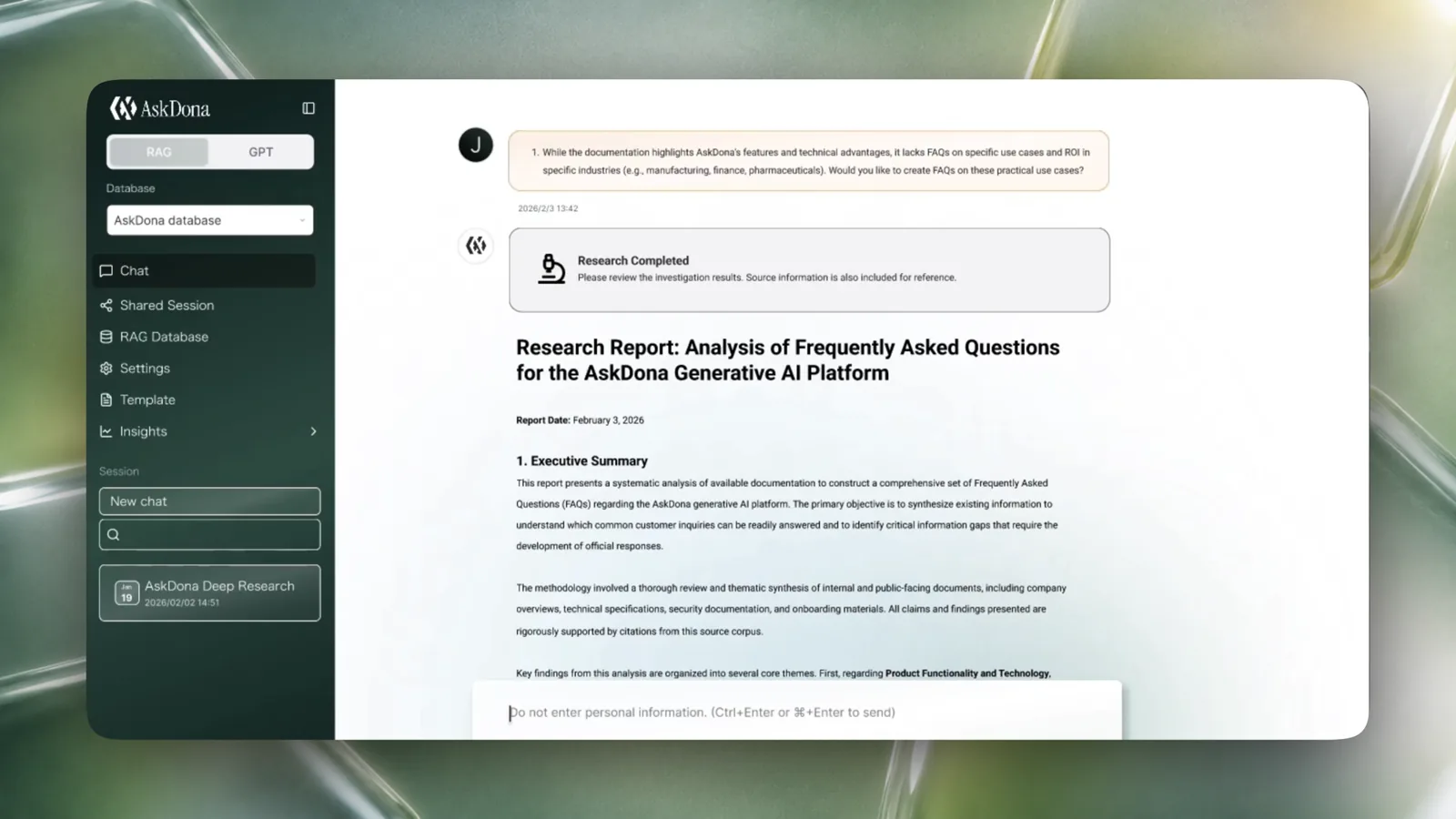
高性能なRAG (Retrieval-Augmented Generation) 技術と高度なデータ処理能力により、ご利用いただく組織が保有するお手元のデータを整備・チューニングすることなく、知識データベースに登録後、回答精度90% 以上を実現します。 High-performance RAG (Search Augmentation and Generation) technology and advanced data processing capabilities enable high response accuracy of over 90% even with large amounts of data.

RAG導入時にこんなお悩み
ありませんか?
Do any of these sound familiar
when adopting RAG?

社内ドキュメントの活用に関するお悩み Challenges in utilizing internal documents

繰り返される問い合わせをAIに任せたい。 We want AI to handle our repetitive inquiries.

  • データが大量にあり、どのファイルに必要な情報があるかを探すことに時間がかかっている There's so much data that finding the right file takes too long.
  • 社内ドキュメントそのものが複雑で、ファイルも複数あるため読んで理解することが大変 Internal documents are complex and scattered across multiple files — hard to read and understand.
RAG内製化の落とし穴 Pitfalls of building RAG in-house

RAGを内製化したものの、期待した回答精度まで上がらない We built RAG in-house, but accuracy never reached our expectations…

  • データ量が増えるほど、生成AIの回答が的外れになってしまう As data volume grows, the AI's responses drift further off-target
  • RAGのポテンシャルは感じるけど、組織全体での活用方法が見えない We see RAG's potential, but don't know how to roll it out across the organization
RAG導入のよくある課題 Common RAG challenges

メンテナンスや改善に手が回らず、RAGが形骸化してしまっている。 Maintenance and improvements lagged, making RAG ineffective.

  • RAG導入に挑戦したものの、回答精度が向上せず頓挫してしまった We tried implementing RAG, but accuracy didn't improve and the project stalled.
  • RAGの効果測定が難しく、投資対効果が見えづらい It's hard to measure RAG's effectiveness, making ROI unclear.

RAGとは何で、なぜ必要なのか? What is RAG and why do we need it?

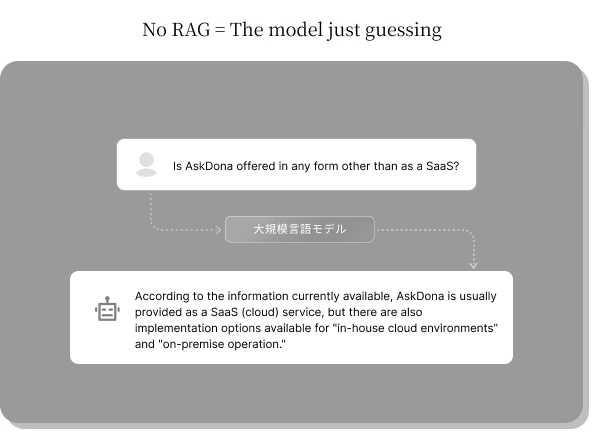
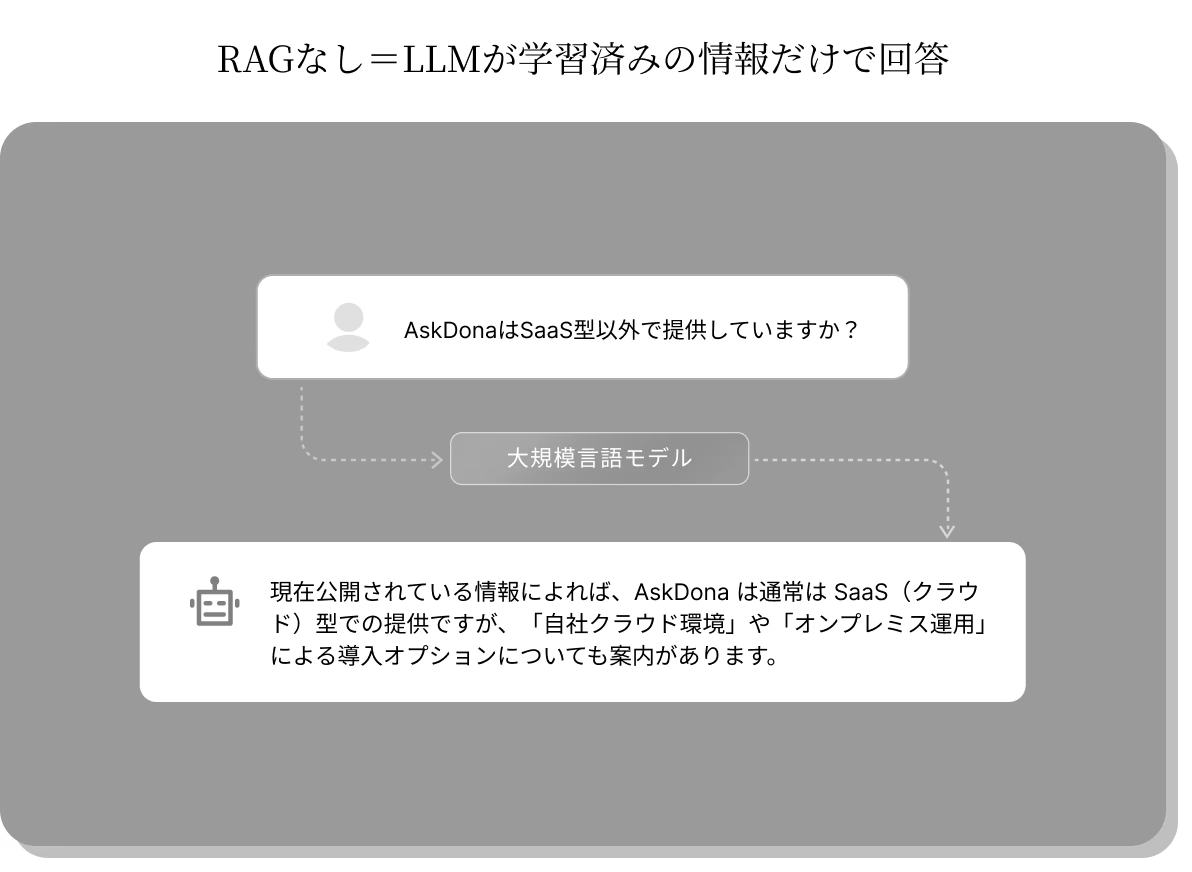
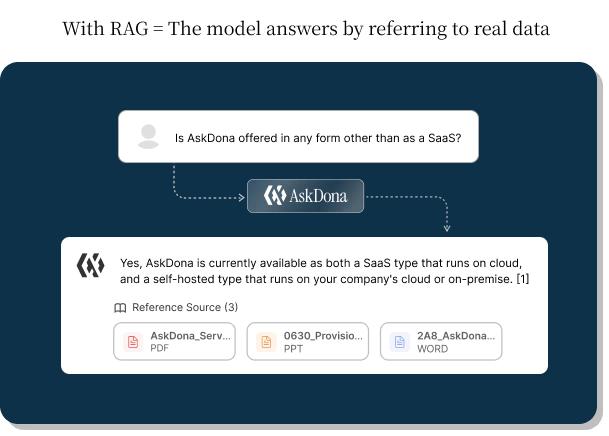
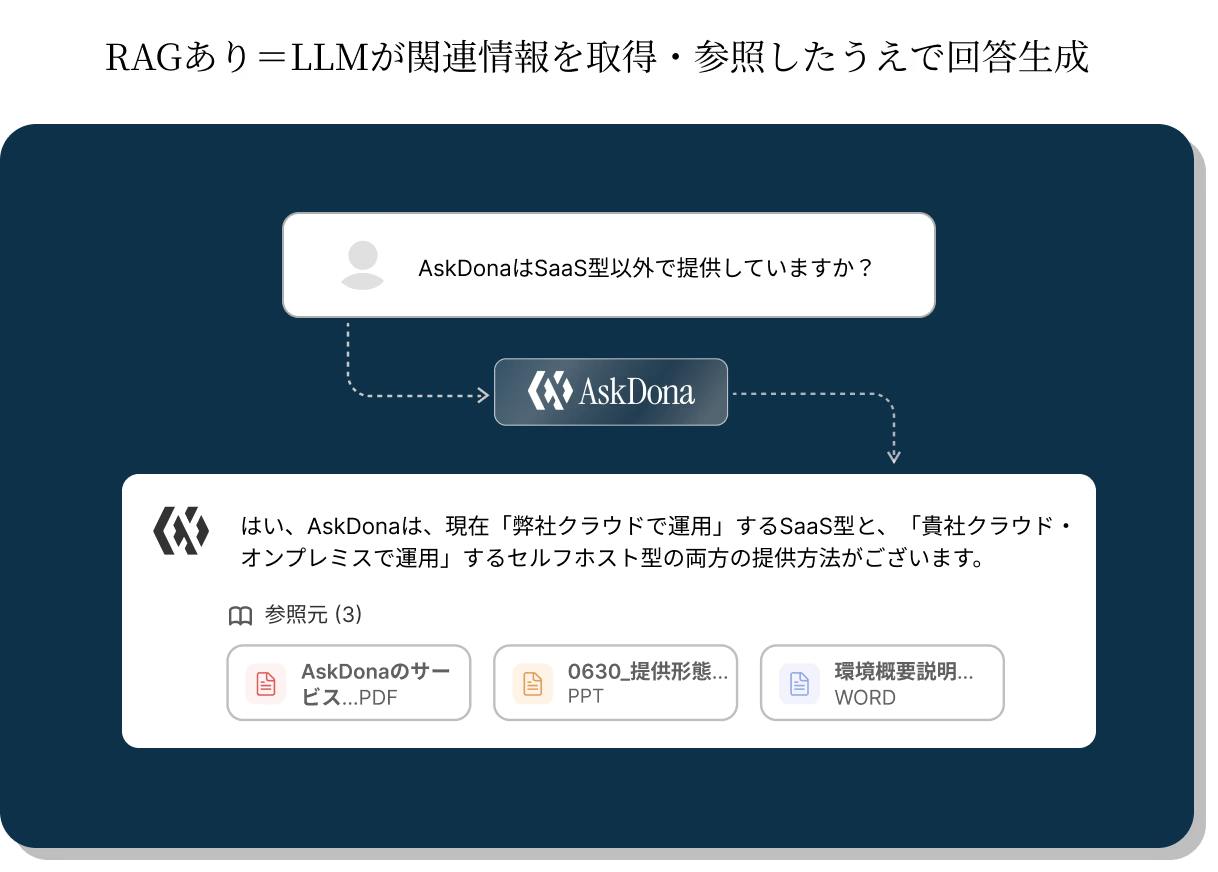
RAG(検索拡張生成)とは、LLM(大規模言語モデル)が回答を生成する前に、
外部データ(ドキュメントやナレッジベース)を検索して参照できるようにする仕組みです。
LLMが学習済みの情報だけで回答するのではなく、関連情報を取得・参照したうえで生成するため、より正確で根拠のある回答が可能になります。
RAG (Retrieval-Augmented Generation) is a method that improves AI accuracy
by letting a language model search and reference external data (documents, knowledge bases) before generating an answer.
Instead of guessing from its training data alone, the model retrieves relevant information and uses it to produce more reliable, fact-based responses.

R

Retrieval / 検索 Retrieval

LLMが回答を生成するにあたって必要となる関連情報をデータベースから検索取得するステップ。 The step where the AI searches for and gathers relevant information.

A

Augmented / 拡張 Augmented

外部から追加情報をLLMに与えることで知識を拡張すること。 "Enhanced" or "strengthened." The retrieved information is used to boost the model's abilities.

G

Generation / 生成 Generation

取得した情報を踏まえ、十分な文脈が与えられた状態でLLMが回答を生成するプロセス。 The AI creates the final answer or text using the enhanced information.

RAG concept diagram 1 RAGコンセプト図1
RAG concept diagram 2 RAGコンセプト図2

AskDona: dona-rag-2.0 AskDona: dona-rag-2.0

AskDona(dona-rag-2.5)の基盤となるRAG(検索拡張生成)は、独自の仕組みで構築されています。
ユーザーは管理画面上で、3つのステップ(「アップロード」「メタデータ編集」「処理」)を実行することで、下記の複雑なプロセスをまとめて実施できます。AskDonaの特長は高い回答精度です。各プロセスを通じてデータが適切に処理されることで、根拠に基づく精度の高い回答を実現します。
AskDona (dona-rag-2.0)'s underlying RAG (Retrieval-Augmented Generation) is built with a proprietary mechanism.
By performing three steps—"Upload," "Metadata Edit," and "Process"—on the administration console, users can handle the complex processes described below. A key feature of AskDona is its very high answer accuracy, made possible by properly and precisely processing the data through each process.

4つのモデルで、検索精度を底上げする Four models that lift retrieval accuracy

事前プロセスとは、本番運用(ユーザーへの回答提供)を開始する前に、回答の根拠となる情報源(ドキュメント等)を整備し、ナレッジベースとして構築する一連の工程を指します。AskDonaでは、RAGChatの機能を通じて、利用者ご自身で事前プロセスを実施できます。画面の案内に沿ってデータをアップロードし、「処理」を実行すると、AskDona(dona-rag-2.0)の処理プロセスがバックグラウンドで自動実行され、ナレッジベースを構築できます。お手元のデータはQ&A形式に作り替えたり、学習用に加工・整形したりする必要はありません。そのままアップロードでき、チューニングも不要なため、短期間で高品質な回答が期待できます。 The pre-processing phase refers to the set of steps carried out before live operation begins (providing answers to users), in which the documents and other information sources that serve as the basis for responses are prepared and organized into a knowledge base. With AskDona, users can perform this pre-processing themselves through the RAGChat feature. By following the on-screen guidance to upload data and executing the "Process" action, AskDona (dona-rag-2.0) automatically runs its processing workflow in the background and builds the knowledge base. There is no need to convert your data into a Q&A format or to manually process or format it for learning purposes; the data can be uploaded as-is, and because no tuning is required, high-quality responses can be achieved in a short time.

Model 01

情報抽出モデル Information Extraction Model

手元のドキュメントを「アップロード」し「処理」を実行すると、ドキュメント内のテキストだけでなく、画像、表、図、グラフなどを含む情報を抽出します(情報抽出モデル:Information Extraction Model)。画像については、周辺テキストの読み取り(OCR)にとどまらず、画像の意味や、矢印・グラフ・表などの要素間の関係性も解析し、内容を理解したうえでデータを抽出します。また、数式や化学式にも対応しているため、学術論文や研究データの内容も正確に取り込めます。さらに、組織固有の固有名詞を用語集として登録することで、ナレッジグラフのような関係性を伝えられる構造でデータを抽出できる仕組みも備えています。 When you "upload" the documents at hand and click "process," the system extracts information including text, images, tables, figures, and graphs contained in the document (Information extraction model). The model not only reads the surrounding text of images, but can also interpret the meaning of the images, the relationships between arrows, graphs, and tables, understand their semantics, and store them as data. It also supports mathematical formulas and chemical formulas, enabling accurate reading of academic papers and research data. In addition, by registering proper nouns specific to the organization as a glossary, the system is equipped with a mechanism that allows data to be extracted in a structure capable of conveying relationships like a knowledge graph.

対応ファイル形式 Supported formats
  • .pdf
  • .doc
  • .docx
  • .xls
  • .xlsx
  • .xlsm
  • .ppt
  • .pptx
  • .csv
  • .json
  • .html
  • .htm
  • .md
  • .png
  • .jpg
  • .jpeg
  • .zip
  • .txt
Model 02

セマンティック分割モデル Semantic Chunking Model

セマンティックとは、抽出された情報の「意味」と「文脈」が適切に解釈できる形に整形・構造化することを指します。AskDonaの情報抽出モデルで抽出された情報は、AskDonaのセマンティック分割モデルによって、段落や文章の文脈を踏まえながら構造化データとして適切に分割されます。データを構造化することで、質問を受けた際に、情報源を「意味のあるまとまり」として活用しやすくなり、不自然な箇所で切られた文ではなく、意味のあるチャンクとして活用できるようになります。 Semantic refers to a concept of formatting and structuring extracted information so that its "meaning" and "context" can be properly interpreted. The information extracted by AskDona's information extraction model is segmented appropriately as structured data with consideration of paragraph and sentence context by AskDona's semantic chunking model. By structuring the data, when receiving a question, it can be utilized as an appropriate information source and can be used as meaningful chunks rather than as sentences cut in unnatural places.

Model 03

メタデータ抽出モデル & エンベディングモデル Metadata Extraction Model & Embedding Model

構造化されたデータは分割されるだけでなく、各意味のあるチャンクがどのような目的を持ち、どのカテゴリに属するのかを示すメタデータが自動的に付与されます。一部のメタデータは利用者が手動で付与することもでき、これが「メタデータ編集」のプロセスにあたります。構造化データは同時にベクトルデータとして保存され、各種検索手法で検索可能な状態でベクトルデータベースに蓄積されます。 The structured data is not only segmented, but is automatically assigned metadata that indicates what purpose each meaningful chunk has and which category it belongs to. Some metadata can also be manually assigned by the user. This corresponds to the "Metadata Edit" process. Structured data is simultaneously stored as vector data and accumulated in a vector database in a searchable state using various retrieval methods.

事前プロセス全体は、AskDonaの管理画面から実行できます。「アップロード」ボタンからドキュメントをアップロードすると、データは事前プロセスのパイプラインに入る前の状態で保存されます。「メタデータ編集」をクリックすると、必要に応じて任意のメタデータを設定できます。メタデータとは、構造化データの内容や特徴を表す追加情報のことです。メタデータは自動で付与されますが、利用者が任意のメタデータを付与することで、回答がユーザーの意図をより正確に反映できるようになります。たとえば、回答生成で参照元URLを表示したい場合、「URL」というメタデータキーに「https://」のような値を割り当てると、AskDonaは生成された回答に参照元URLを表示できます。 The entire pre-processing flow can be executed from AskDona's administration console. When you upload a document via the "Upload" button, the data is stored in a state prior to entering the pre-processing pipeline. By clicking "Metadata Edit," you can set metadata manually if desired. Metadata refers to additional information describing the content and characteristics of structured data. Although metadata is automatically assigned, attaching user-specified metadata enables answers to more accurately reflect user intent. For example, if you want to display the reference URL in answer generation, you may assign a metadata key "URL" with a value like "https://", which allows AskDona to display the reference source URL in the generated answer.

リアルタイムプロセス(回答生成の質の向上) Real-time processing

ユーザーが質問を送信すると、AIエージェントが質問の意図や前提・背景を要素分解し、観点を変えた複数のサブクエリを生成します(サブクエリ化)。ユーザーのメインクエリとサブクエリを用いて、それぞれに適した情報源を各種検索手法で取得します。たとえば、特定のキーワードに一致する情報源が必要な場合はキーワード検索を行い、文脈にもとづく検索が必要な場合はベクトル検索(近似ベクトル検索)を用いて関連情報を見つけ出します。AskDonaではこの組み合わせ検索手法を「ハイブリッド検索」と呼んでいます。必要な情報源が揃ったら回答生成を実行します。情報の正確性を担保するため、引用にもとづいて回答するよう生成AIへ明確に指示する仕組みを組み込んでいます。ハルシネーションを低減し、参照元のどの箇所が根拠かを確認できるよう、信頼性の高い回答を提示します。 When the user sends a question, an AI agent factorizes the intent and background of the user's question and generates several alternative queries from different perspectives (sub-querying). The user's main query and the sub-queries retrieve appropriate answer sources through various search methods. For instance, if sources that match specific keywords are needed, a keyword search is performed, and if searching based on sentence context is needed, a vector search that finds approximate vector matches is applied to locate relevant information. AskDona calls this combined search method "hybrid search." After all appropriate information sources for the primary and sub-queries are gathered, answer generation is executed. Here as well, to ensure correctness of information, a mechanism is embedded that gives explicit instructions for citation-based answer generation to the generative AI. To reduce hallucination and allow the user to verify which parts of which reference source produced the information, the answers are designed to be highly accurate and reliable.

AskDonaのリアルタイムプロセスでは、ユーザーの質問の未熟さ(どのような質問が適切な回答を引き出すかを知らないこと)が課題として表れることがあります。たとえば、新卒や中途入社の社員を想像してみてください。優秀であっても、組織知識の不足により、必要な前提を知らなかったり、自分の知識を超える未知の領域の存在に気づけなかったりする場合があります。 In AskDona's real-time processing, the immaturity of user questioning—such as not knowing what kind of question yields appropriate answers—can be reflected as a challenge. For example, imagine a new graduate or mid-career employee; even if they are competent, due to a lack of organizational knowledge, they may not know the necessary premises or even recognize the existence of unknown areas beyond their knowledge.

AskDonaのメタデータは、事前プロセスでの整理にとどまらず、リアルタイムプロセス(質問→検索→回答生成)においても有効に活用できます。あらかじめ利用者が任意で設定したメタデータ(キー/値)を検索条件として使うことで、回答生成時の検索対象を適切に絞り込んだうえで質問を実行できます。 AskDona's metadata is useful not only for pre-processing organization, but also in real-time processing (question → search → answer generation). By using user-defined metadata (key / value) as search criteria, the search target can be appropriately narrowed at answer-generation time before running the query.

この仕組みにより、データを部署や事業ごとに分断して管理することで発生しがちな「データサイロ化」の課題にも対応できます。AskDonaでは、データを基本的に一箇所に集約しつつ、メタデータによって検索範囲を制御できるため、全社横断で探したいときは広く、特定目的で探したいときは狭く、という両立が可能になります。異なる事業目的のデータを一箇所に共存させながら、横断検索と個別検索の両方を実現したいユースケースに適した設計です。 This mechanism also addresses the "data-silo" problem that arises when data is fragmented across departments and business units. AskDona consolidates data in one place while controlling search scope via metadata — broad when you want to search company-wide, narrow when you want a specific domain. The design fits use cases where data with different business purposes coexists in one place and both cross-data and domain-specific search are required.

「Day1から精度が高い」
が新しいスタンダード。
High accuracy from Day 1
is the new standard.

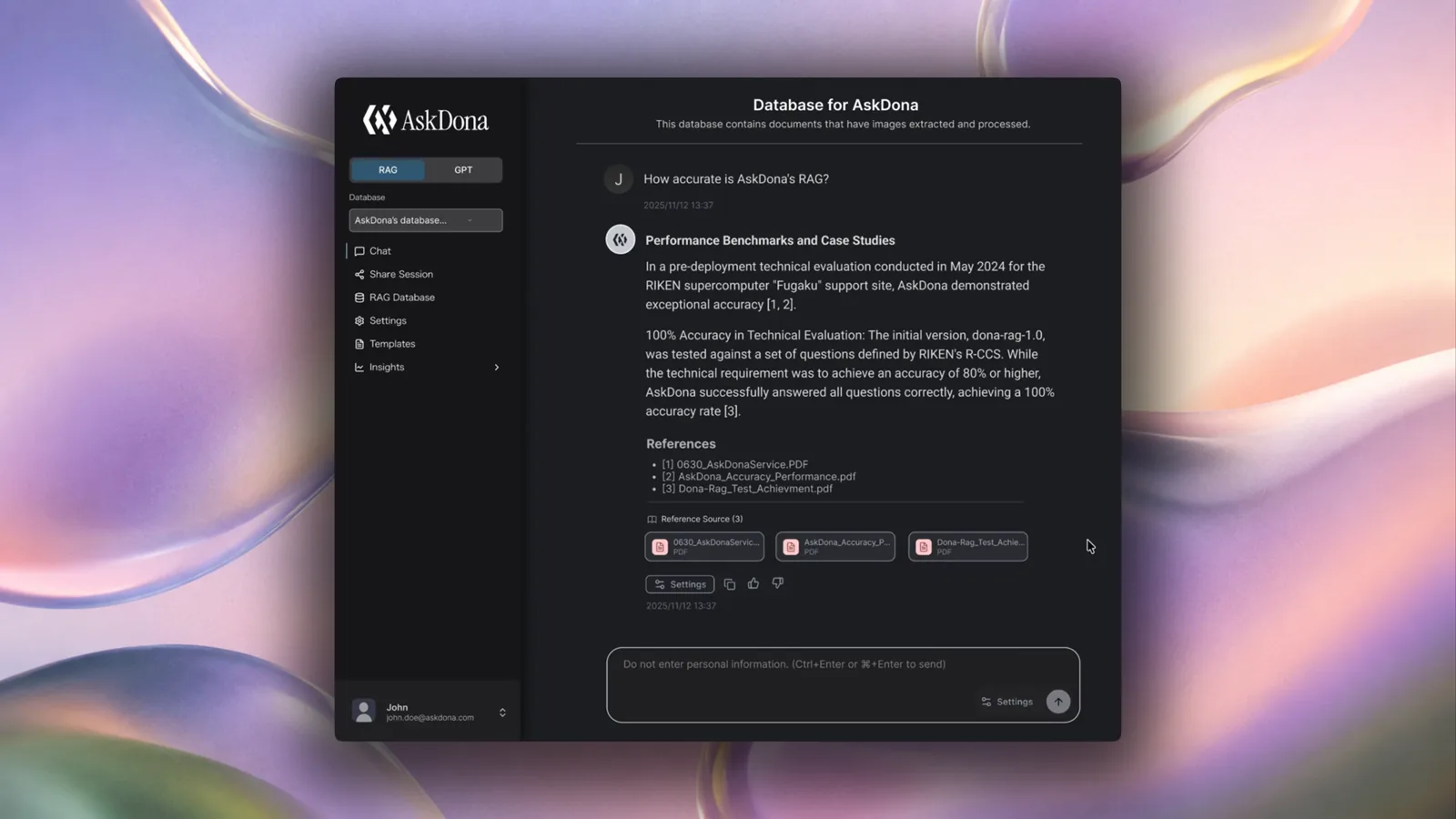
AskDonaの「dona-rag-2.0」は、チューニングやデータ加工の工数を要さず、初期段階から高精度な回答を実現します。スーパーコンピューター「富岳」を運用する理化学研究所R-CCSとの共同検証により、他社製品より20ポイント差以上、精度が高いことを実証済みです。 AskDona's "dona-rag-2.0" delivers high-accuracy answers from the initial phase without requiring tuning or data preprocessing. Joint verification with RIKEN R-CCS, the organization operating the supercomputer "Fugaku," has demonstrated that it achieves accuracy more than 20 points higher than competing products.

ご導入担当者は精度向上のために時間を使うのではなく、AskDonaを組織の知識として活用するための価値創出に専念することができます。技術的な懸念事項を早期にクリアできるため、検証フェーズをクイックにクリアし、機会損失を生むことなく、迅速に本格運用へのフェーズ移行を実現します。 Instead of spending time on accuracy improvements, the person in charge of implementation can focus fully on creating value by leveraging AskDona as organizational knowledge. By resolving technical concerns early, the verification phase can be cleared quickly, enabling a smooth transition to full-scale operation without causing opportunity loss.

よくあるご質問 Frequently asked questions

はい、RAGのデータベースにアップロードされたファイルは日本国内のサーバーで管理されます。 Yes — files uploaded to the RAG database are managed on servers within Japan.

はい。ログイン後の認証情報に基づき、お客様のデータに対して厳格な論理的分離を実施しています。そのため、他のお客様のデータにアクセスすることはない仕様となっています。 Yes. AskDona enforces strict logical separation of customer data based on login credentials, so other customers cannot access your data.

会社のポリシーで社内データの社外持ち出しができない企業様向けに、自社で契約しているクラウド (AWS、GCP) でAskDonaを導入する方法もございます。詳しくはお問い合わせください。 For organizations whose policies prohibit moving internal data outside, AskDona can also be deployed into your own contracted cloud (AWS, GCP). Contact us for details.

PDF、Word (.docx)、PowerPoint (.pptx)、Excel (.xlsx)、CSV、HTML、Markdown、画像ファイルなど主要なフォーマットに対応しています。容量や運用条件の詳細はお問い合わせください。 AskDona RAG supports major formats — PDF, Word (.docx), PowerPoint (.pptx), Excel (.xlsx), CSV, HTML, Markdown, and image files. Contact us for capacity and operational limits.

いいえ。AskDonaに送信される質問やアップロードしたファイルなどのデータが、ChatGPTなど生成AIモデルの学習に利用されることはありません。今後採用する生成AIモデルについても、学習にデータを使わない契約のものに限定する方針です。 No. Questions and uploaded files sent to AskDona are never used to train ChatGPT or other generative-AI models. Any models we adopt going forward will be limited to those covered by no-training-on-customer-data agreements.